

There are shows we remember because they seamlessly transport us elsewhere — be it a different, remote epoch, a surreal fantasy, or a faraway continent. Others feel worthwhile because they put us face-to-face with stories and narratives we had never even considered until that moment, bringing us closer to communities, carefully preserved traditions, and ways of being other than our own.
Unveiled at Tate Modern on February 27, Tracey Emin: A Second Life entrances you with its filterless, bittersweet portrayal of what it means to be uncompromisingly alive against all odds. Between glowing neons, large-scale installations, monumental canvases, and archival footage, its immersive set design will make you feel attentive and present, thanks in part to a grounding night-sky blue backdrop, chosen from Farrow & Ball’s best paint colors.
The color? Stiffkey Blue, and as Livingetc‘s executive editor Pip Rich, who toured the new exhibition with Farrow & Ball’s Joa Studholme and Tracey’s creative director Harry Weller last week, tells us: “Stiffkey Blue reads so much blacker here than I’m used to it being, and reminded me how clever Farrow and Ball is with its pigments that change so subtly depending on how the paint is used.”
One of the most anticipated art exhibitions on the 2026 London cultural calendar, this landmark presentation retraces four decades of Tracey Emin’s provocative production across painting, sculpture, photography, quilting, ephemera, home-inspired displays, and audiovisual works, wrapping you in a tranquil marine palette that makes her artworks feel even more urgent, compelling, and soul-piercing.
“Tracey Emin: A Second Life” Captures the Highs and Lows of Being Alive

Tracey Emin: A Second Life. Tate Modern installation view with My Bed (1998) and It’s Not me That’s Crying its my Soul (2001).
(Image credit: Jai Monaghan © Tate)

Tracey Emin: A Second Life. Tracey Emin with It’s Not the Way I Want to Die (2005) and I needed you to love Me (2023).
(Image credit: Sonal Bakrania © Tate)
It does so by throwing it back to the early days of Tracey Emin’s career, which was heralded by the shocking and deeply divisive yet ever-relevant My Bed (1998), retracing the life of the Royal College of Art alumna and prominent YBAs’ member almost step by step via moments of pleasure, of joy, of heartbreak and pain, of illness, of healing, and becoming.
A life-size reproduction of her messy bed, sided by an unruly pile of worn knickers, empty alcohol bottles, used and unused condoms, cigarette ends, a cuddly toy, Polaroids, slippers, and more, that seminal piece stood as a tangible portrayal of the inner and outer turmoil of a particularly challenging, depressive chapter of hers.

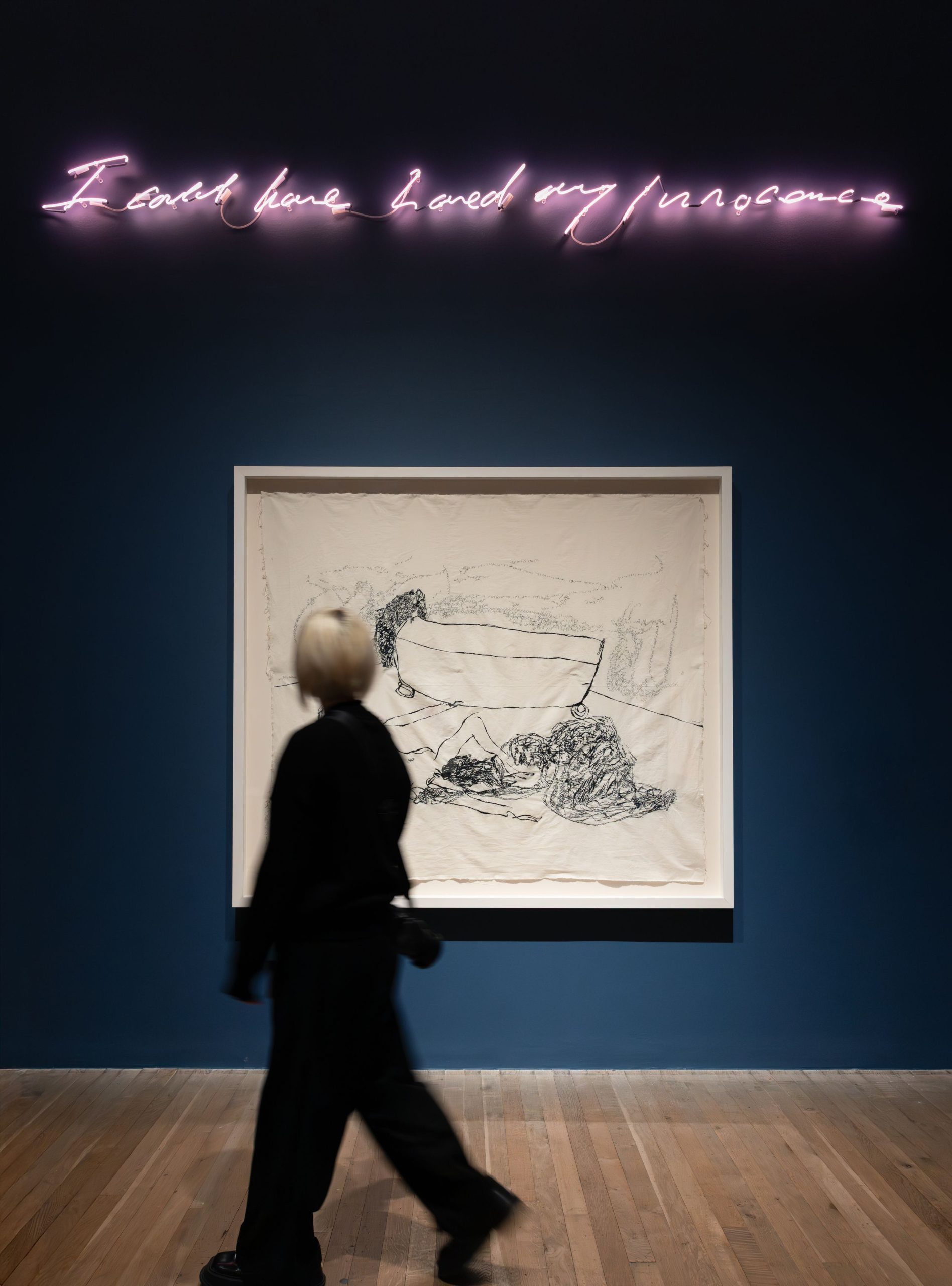
Tracey Emin: A Second Life. Tate Modern installation view of Keep your Darkness Away (2011) and I could have Loved my Innocence (2007).
(Image credit: Sonal Bakrania © Tate)
My Bed debuted at the Sagacho Exhibition Space in Tokyo, Japan, in 1998, and was first presented in London, where it’s now on view, within the 1999 Turner Prize showcase at the Tate Gallery, causing shock, disgust, and confusion in equal amounts, before going on to rewrite the definition of art.
Tracey Emin: A Second Life unofficially takes this revealing display as its centerpiece. It also features a series of haunting self-portraits that see the maverick reflect on her experience of rape and sexual assault as a teenager, and others she painted in the aftermath of her squamous cell bladder cancer diagnosis, which she received in 2020.
…and the Sensory, Visceral Essence of It All

Tracey Emin: A Second Life. Tate Modern installation view with Naked Photos – Life Model Goes Mad (1996).
(Image credit: Sonal Bakrania © Tate)

Tracey Emin: A Second Life. Tate Modern installation view with Why I Never Became a Dancer (1995).
(Image credit: Yili Liu © Tate)
The show doesn’t shy away from the debilitating impact this and the surgery that followed it had on the artist — having had her bladder, urethra, uterus, ovaries, lymph nodes, and parts of her intestine removed, she now lives with a permanent disability, and often turns to art to document it — but feels, nonetheless, life-affirming.
Inspired by the unexpected hue obtained from the mixing of mud and crushed cockles on the beach on the Norfolk coast after which the paint has been named, Farrow & Ball’s Stiffkey Blue inserts another layer of poetry into an exhibition so powerful and raw that it quite literally keeps you on your toes.

Tracey Emin: A Second Life. Tate Modern installation view with The Last of the Gold (2002).
(Image credit: Sonal Bakrania © Tate)
The hue, which was picked by long-term Farrow & Ball admirers Tracey Emin and her creative director, Harry Weller, deepens “the emotional impact of Tracey’s visceral works,” Farrow & Ball’s color curator Joa Studholme said after touring the exhibition alongside the latter last week — an experience she describes as “fascinating, inspiring, and harrowing.”
Inky, pasty, and imbued with an earthy quality, Stiffkey Blue feels like a fitting choice for the background of Tracey Emin: A Second Life, where the filthiness of the human experience’s darkest sides is put on a stage, scrutinized, and, in doing so, exorcized, making room for newfound, explosive energy.

Tracey Emin: A Second Life. Tate Modern installation view with I Am the Last of My Kind (2019), Was Too Young to Be Carrying Your Ashes (2017-2018), and And So It Felt Like This (2018).
(Image credit: Sonal Bakrania © Tate)
It makes the trio of nudes gathered by Emin’s Naked Photos – Life Model Goes Mad (1996) and captured above truly pop out against the pale blue of the flooring onto which the female protagonist of these shots is shown mixing colors, lying on a dark sheet of fabric, and painting.
Elsewhere in the exhibition, like in front of I Am the Last of My Kind (2019), Was Too Young to Be Carrying Your Ashes (2017-2018), and And So It Felt Like This (2018), the muted blue shade gives each artwork the semblance of a portal.
Three female silhouettes, rendered in turquoise and pink, fire red and black, and darker blue, purple, and red, respectively, stare back at viewers, ghostly embodiments of loneliness, grief, and physical trauma, as the darker walls recall the attention onto their agitated surfaces.

Tracey Emin: A Second Life. Tate Modern installation view with I Will not Be Alone (2025) and Meet Me In Heaven, I Will Wait For You (2004).
(Image credit: Sonal Bakrania © Tate)
Combined with Tracey Emin’s signature neon sculptures — striking windows into her desires and thoughts — the Farrow & Ball-authored backdrop looks like a starry night, or a dead calm sea with twinkling boats all over it.
“The Margate of my mind has the most beautiful sunsets that stretch across the entire horizon. Sharp white cliffs divide a charcoal blue sea from the hard reality of the land,” the artist wrote of the place where she grew up in her book Strangeland. Tracey Emin: A Second Life cements her ability to reunite both in her work — passion, beauty, and hardship — without ever quenching her lust for more.
Tracey Emin: A Second Life is open at Tate Modern, London, through August 31. Book your tickets

Tate
Tracey Emin: a Second Life (Paperback)

Farrow & Ball
Stiffkey Blue

Marsilio
Tracey Emin: Sex and Solitude
Read about interior designers’ favorite spring colors yet? You’ve still got time to catch up on the homework before the summer solstice lands on June 21. For more style advice, consider joining our community of subscribers for access to our weekly newsletters — a seasonal upgrade has never been more of a no-brainer.
TOPICS
