

This time it’s personal . . . .
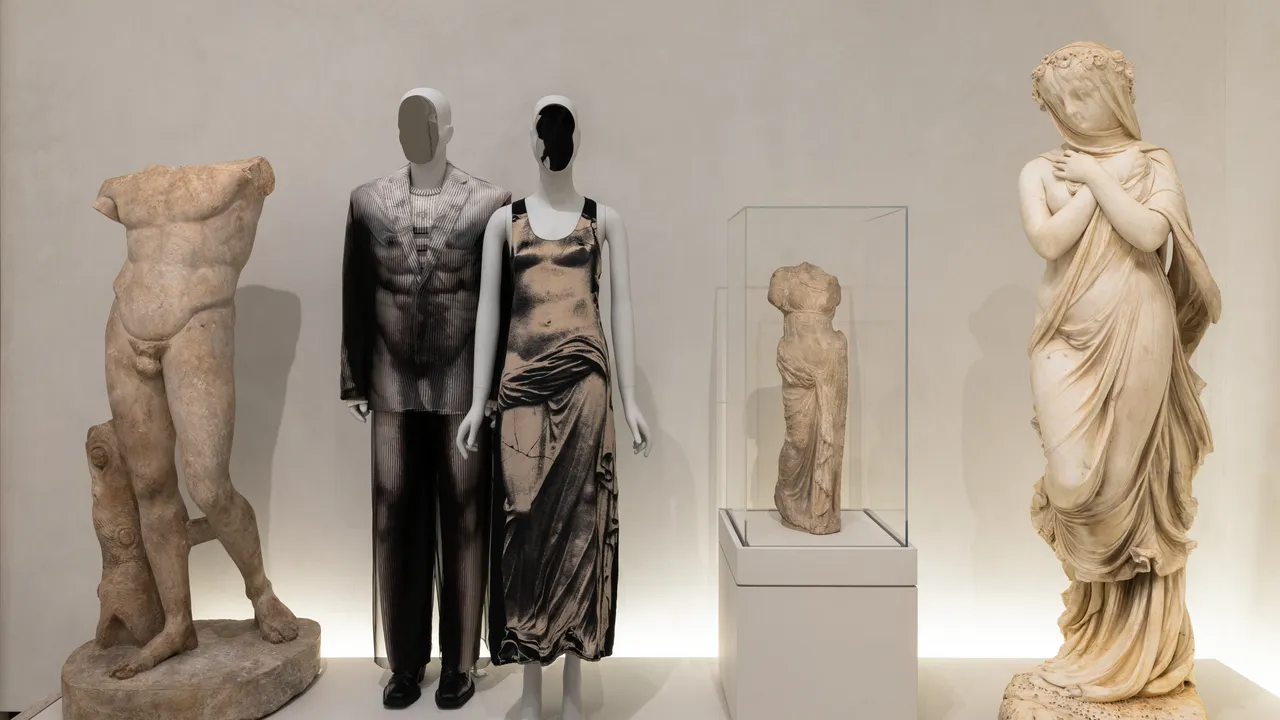
It’s next to impossible to walk through “Costume Art,” the Met’s blockbuster fashion exhibition, as an impassive observer. Active looking is more than encouraged, it’s required because one’s own visage appears in the flat, reflective surface of the faceless mannequin heads created by sculptor Samar Hejazi. The idea, curator Andrew Bolton said, is “to reflect on your own lived experience, hopefully to create a connection, empathy, compassion towards each other.”
Not only does this interactive element transform a visit to the museum into a small voyage of self discovery, but it is a bodily experience that cannot be replicated digitally. This at a time when humans are being replaced by machines and AI anxiety is pervasive.
Bolton—the man who a decade ago dreamed up “Manus x Machina,” an exhibition about the happy coexistence of humans and technology—is once again a step ahead of the rest of us in focusing on physicality and dimensionality in a visual world that favors flatness. After all, what could be more materially foundational than the human form?
“The whole show [is] structured around a typology of bodies, and these are bodies that you see across the museum when you encounter artworks,” Bolton explained. “The simple thesis for the show really is the fact that the dressed body is the connecting thread throughout the entire museum.” What you won’t see anywhere else at the Met are mannequins of diverse body types modeled after named individuals, like those commissioned for “Costume Art.” And this is transformative in many ways. As the scholar Llewellyn Negrin notes in her catalog introduction, not only do mannequins project a beauty standard, but their “dimensions often dictate the sizes of the garments shown, and the garments’ sizes correspond to the idealized proportions of the preferred mannequins, resulting in a mutually reinforcing process that perpetuates the privileging of culturally esteemed body types.”
Before getting into the organization of the exhibition, it’s important to address some of the frameworks around the show, especially regarding fashion’s changing relationship to art. In this age of individuality, where images are the common currency, and keeping up appearances (often through clothing) is a blood sport, interest in fashion has grown and it has become ever more integrated into all aspects of culture. This has affected its standing in the art world in general, and in museums where the subject is a big draw for visitors. Three of the Met’s most attended exhibitions of all time were organized by the Costume Institute, with “Heavenly Bodies: Fashion and the Catholic Imagination” 2018 holding the number one spot.
Same Date, New Location
With the opening of the new, permanent Condé M. Nast Galleries just off the Great Hall, the Costume Institute’s exhibitions have a beautiful new home. (One of the many benefits of the space is that it allows for longer periods of display.) You might even say that Cinderella has finally made it to the ball—although “Costume Art’s” messages of acceptance and plurality run counter to the fairytale’s idea of a perfect fit being necessary for entry.
Fashion’s association with femininity, and by extension, frivolity, have long distanced it from high art. “There’s always been sort of an inherent sexism around fashion as a discipline,” Bolton said, “but I think . . . the fact that fashion has been sort of excluded from the history of aesthetics [is] because of the proximity of the body.” Also contributing to clothing’s stepsister position is the view, he noted, that it is “something that’s sort of decorative or illustrative or supplemental.” In addition, there is a sort of inherent unruliness attached to garments, which are highly tactile and are completed by (and destined for) the human form, whereas paintings and sculptures are more self-contained and “heady.” The mind/body divide is another truism Bolton wants to invert.
