

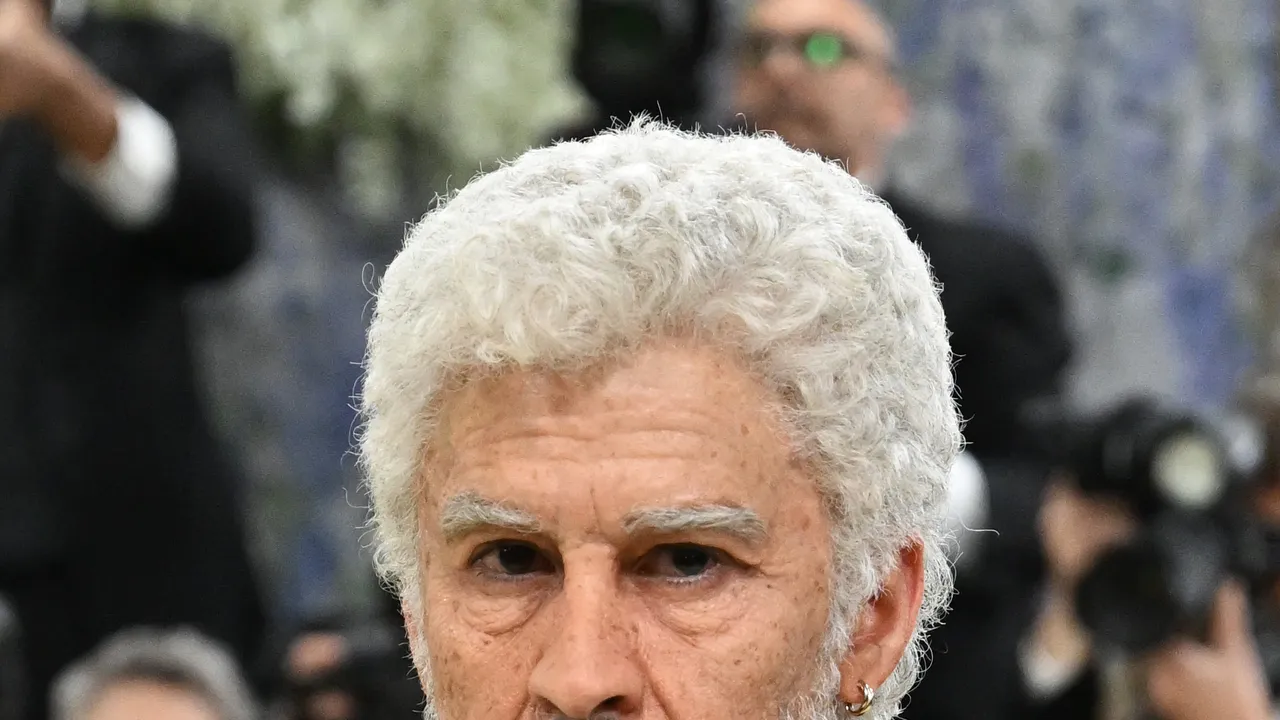
“It took 53 years.” That’s how long Bad Bunny joked his old-age transformation took for the 2026 Met Gala. In reality, according to his prosthetics designer, Mike Marino, the process took three hours—plus a half hour of makeup removal at the end of the night (micellar water, in this instance, would not cut it). Then there was the six weeks of prep: the scanning, designing, sculpting, and sewing until the multiple, hyper-realistic prosthetic pieces were complete.
Never one to follow the crowd, Benito Antonio Martínez Ocasio chose to tap into a section of the Costume Art exhibition that focused on bodies often overlooked in fashion and art, such as pregnant and aging bodies. Set on exploring aging as an art, the singer’s team reached out to Marino, whose award-winning prosthetic designs you can spot in films like The Batman and The Irishman, and series like The Penguin and True Detective, not to mention Heidi Klum every Halloween since 2011.
Marino is no stranger to aging people (The Weeknd for his Dawn FM cover, for example) or transforming them completely. (Hours before he began working on Bad Bunny, he was morphing Klum into a marble statue.) But for the singer’s Met Gala appearance, Marino felt he needed a more realistic, and almost regal, approach to the singer’s travel through time. “The fact that he’s distinguished and well-groomed is on purpose,” says Marino, who felt making the singer look weary and hunched would not have felt right for fashion’s most glamorous night of the year.
Marino was also continuing a long tradition in art history of presenting idealized representations of people and the human body. “If you think about famous portrait painters like [John Singer] Sargent and [Diego] Velázquez, they were often painting an idealized image of the subject, manipulating how they look to make them look more beautiful, or more colorful, more powerful in that portrait,” he says, referencing Velázquez’s painting of King Philip IV and the many propaganda paintings of Napoleon I. “I thought it was cool that, with his grooming, he had this distinguished look that was as if a Velázquez or Sargent portrait came to life.”
For ideas on how to most realistically age Ocasio, Marino looked at octogenarian Puerto Ricans, as well as the singer’s own facial structure and skin texture. Turns out, being a prosthetic designer requires the same understanding of facial structure as a plastic surgeon. However, instead of minimizing the signs of aging, they enhance them. “I look at how he might age—that’s how I approach makeup,” Marino says of his process. “I look at signals; for instance, I might see a little line [on the face] and then exploit that line, or I think, maybe this eye-bag will develop this way if he maintains his healthy lifestyle. I’m like someone’s worst nightmare,” he laughs.
Creating Bad Bunny’s prosthetics—including a piece for the neck, cheeks and eye bags, forehead and eyelids, as well as earlobes and hands—was a multi-step process that started with Marino taking skin color samples and a 3D laser scan of his face and head. Those digital scans were then used to create a 3D-printed model of the singer’s head onto which Marino sculpted clay into the shapes that he wanted. “I sculpt every line, every crease, every pore into the clay and that’s what you’ll see on the prosthetics,” Marino explains.
The next steps are a little complicated but those miniature clay sculptures are then used to create molds and eventually cast pieces out of supersoft, superthin silicone, which are the prosthetics that get glued onto the face. “Because Benito had never worn prosthetics before, the pieces were very thin,” explains Marino. I thought it would probably be easier if they were very soft, thin pieces so that you could still feel somewhat normal [wearing them].”
