

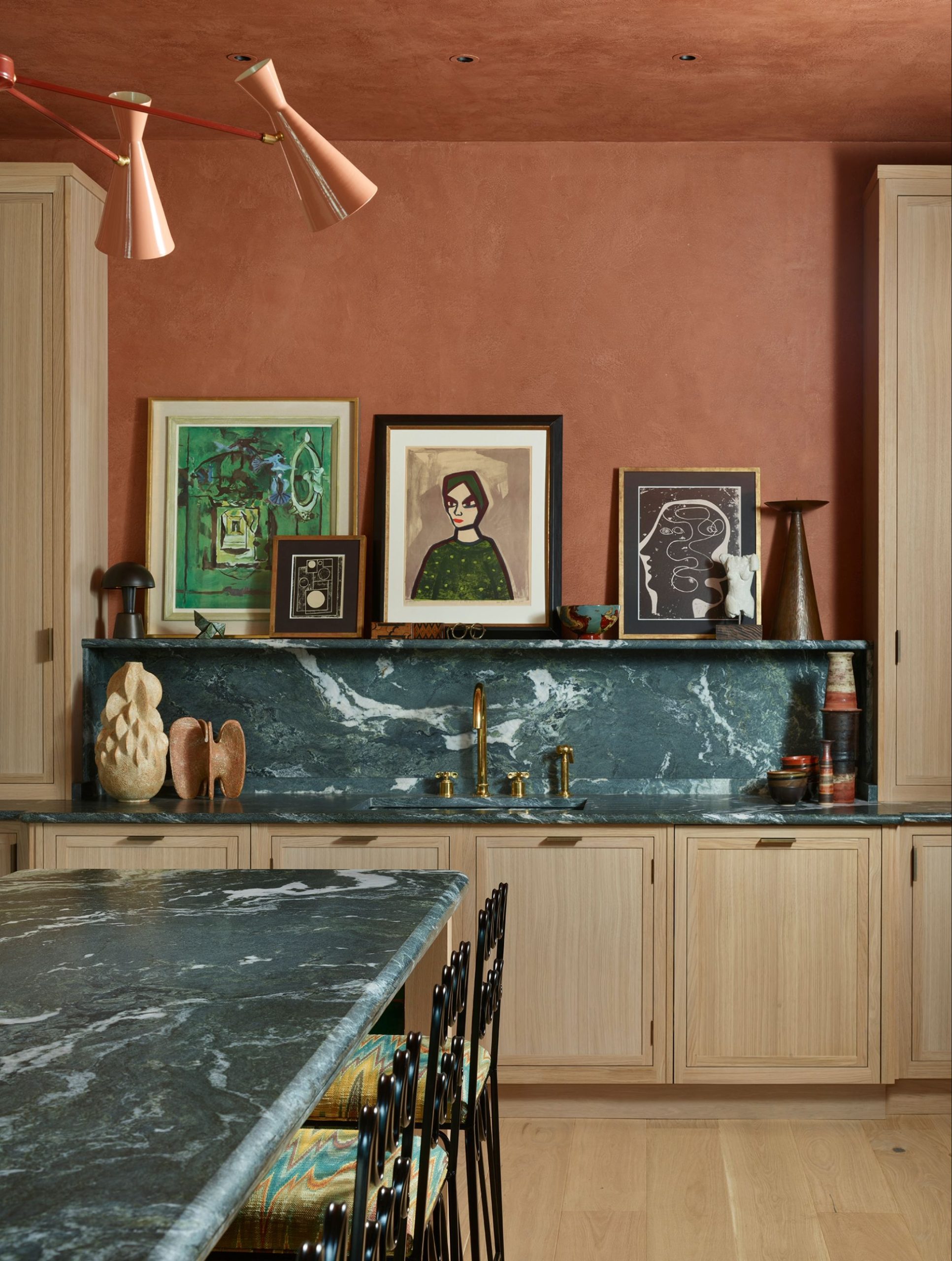
In my recent scrolls through social media, I’ve noticed one particular design detail that keeps unexpectedly appearing above cookers, leaning against upper cabinets, adorning banquettes, and even hanging from kitchen islands: art.
And I’m not the only one. “The kitchen has become one of the most emotionally important rooms in the house,” interior designer Venetia Rudebeck tells me. “It’s no longer just somewhere to cook, but where people gather, work, and host. In many homes, it’s effectively replaced the formal living room, so it makes sense that people want it to feel layered, expressive, and personal.”
When it comes to styling art in the kitchen, though, it’s not always as straightforward as your living room wall. It’s a space that serves a highly functional purpose, so there are practical considerations you need to consider. To get to the bottom of how to make sure your kitchen artwork is serving nothing but good looks, I asked interior designers how to hang art in the kitchen, and here’s what they had to say.


“The slightly informal placement is often what gives kitchens charm,” says Venetia Rudebeck.
(Image credit: Martin Moore. Design: Studio Vero)
“For years, art in kitchens was often treated as secondary — small or decorative prints rather than meaningful pieces,” interior designer Venetia Rudebeck, co-founder of London-based Studio Vero, tells me. “Kitchens were seen as practical spaces that needed to be hardwearing above all else. But there’s something incredibly compelling about placing serious art in a room filled with life and movement.”
So, how should we be styling art in the kitchen instead?
How to Style Art in the Kitchen

“Ultimately, it’s about rejecting the idea that art belongs only in pristine, untouched rooms — it should be part of everyday life,” says Venetia.
(Image credit: Studio Vero)
When it comes to styling art in the kitchen, placement is crucial — not just aesthetically, but for practicality, too. “Avoid hanging valuable pieces directly above heat or steam, for example, but don’t be too cautious,” advises Venetia. “Lean artworks on shelves, place pieces above doorways, layer smaller paintings against splashbacks, or even prop something unexpected at the end of an island,” she adds.
She also says it pays to be “less rigid” about what actually qualifies as art. “A ceramic plate, textile, or vintage object can have the same presence as a painting when displayed thoughtfully,” she shares. And it’s true — there are so many things you can hang on your wall instead of art that can achieve the same goal of adding instant character and personality.

Venetia Rudebeck trained at KLC, where she developed her intuitive and exuberant use of color, and began her career in hotel design before moving into the residential sector. As co-founder of Studio Vero, she brings a considered yet instinctive approach to interiors, curating projects with character and meaning, layering past and present through art, antiques, and personal collections.

“Artwork helps bridge that transition, softening the utilitarian feel of hard materials like stone, steel, and cabinetry and making the room feel more lived-in,” says designer Christian Bense.
(Image credit: Christian Bense)
For interior designer Christian Bense, styling art in the kitchen is a natural response to recent kitchen trends. “As built-in cabinetry gives way to open shelving, banquettes, and freestanding islands, walls and surfaces emerge that invite the same decorative treatment as a living or dining room,” he explains.
As for how he’d do it: “Layering art alongside collected objects gives kitchens a more evolving quality — one that feels assembled over time rather than installed all at once,” he shares. “Artwork fills visual gaps left by reduced cabinetry, certainly, but also helps transform kitchens into spaces that feel warmer, more expressive, and connected to everyday life.”
Artwork mounted on your kitchen island, the back of a banquette, or on a shelf in your glass-fronted cabinets? Why not.

Christian Bense is a South African-born, London-based interior designer who’s celebrated for his distinctive aesthetic that seamlessly blends contemporary and traditional elements. Known for creating layered, liveable homes full of character, his style is refreshingly approachable, while his work has earned him several notable awards since founding his eponymous studio in 2020.
That said, it’s always wise to frame artwork in the kitchen, ideally behind glass, and positioning it somewhere away from cooking equipment like the hob and oven, advises Hannah Thistlethwaite, a senior buyer at Heal’s.
She also recommends lighting your art with sconces; “Wall lights offer a perfect opportunity to frame a piece of kitchen art, and if supported by shelving, create a real focal point,” she adds.
The Best Style of Art for the Kitchen

Characterful artwork (or sculpture) provides a pop of personality that’s often lacking in such a functional space in the home.
(Image credit: Violet & George)
But it’s not just where you’re styling artwork in your kitchen that matters, but what artwork you’re styling. Nicky Mudie, founder and director of London-based interior design firm Violet & George, says the best art for a kitchen is the least matchy. “I love pieces that bring humor, color, or a bit of surprise into the room, whether that’s a large contemporary painting, vintage food artwork, photography, or even children’s drawings framed properly,” she says, “It helps stop kitchens feeling too showroom-like.”
Hannah Thistlethwaite, a senior buyer at Heal’s, helps people choose art for their kitchens regularly and says it’s about balancing the room’s utilitarian needs with your own personal aesthetic.
“Kitchens are often the heart of the home and run on energy and life, so don’t be afraid to use bold color or interesting subject matters, as these add character and warmth to what can be quite functional spaces,” she says. But, as a starting point, food-related or botanical prints are always a safe bet as they suit the environment, she adds.
Shop Art for Your Kitchen

John Lewis
Kitchen Art ‘Fig’ Hand Painted Wall Art
Part of a set that also includes a pomegranate and tomatoes, this hand-painted fig is a modern take on a still life in warm neutrals. Complement similar kitchen colors for a tonal look.

Nkuku
Kiran Large Textured Wall Art
Textiles in kitchens add a modern twist on artwork and a little texture to spaces usually characterized by hard surfaces. This is handwoven using a loom technique and features a contemporary interpretation of an Indian design in natural tones.

Heal’s
Nay Bellamy Limited Edition Poppy Print
Part of a collection spanning both prints and originals, this poppy artwork is a limited-edition collaboration between Heal’s and Nay Bellamy. It features the artist’s signature floral motifs, graphic stripes, and color-blocking, and is sure to inject personality into your kitchen.

East End Prints
Cacio e Pepe Framed Wall Art
My comfort food? Cacio e pepe — a simple dish of cheese, pepper, and spaghetti — so I couldn’t resist this framed print from Nia Beynon for my kitchen. I don’t usually lean this way, as it’s a little too obvious, but for this, I’ll make an exception.

H&M
Stephie Cardona Poster
Need I really explain? Part of a collection of posters that also feature olives, ‘bon appetit’, and ‘cin cin’, this playful print feels perfectly primed for the kitchen. Plus, the pop of color will pack a punch. Add a contrasting frame to really make it sing.

East End Prints
Bigger Picture Framed Art
The art you style in your kitchen can even be the starting point for the space’s whole color palette, and this bright and cheery piece would help create a truly joyful heart of the home.

Modern kitchen design has opened up a plethora of new surfaces, ripe for decorating.
(Image credit: Studio Vero)
The way you decorate your kitchen isn’t confined to your walls (or what’s on the shelves or side of your island); here are the kitchen material trends that feel the most design-forward right now when it comes to your countertops and cabinetry.
For more inspiration and advice, subscribe to Livingetc’s newsletter.
