

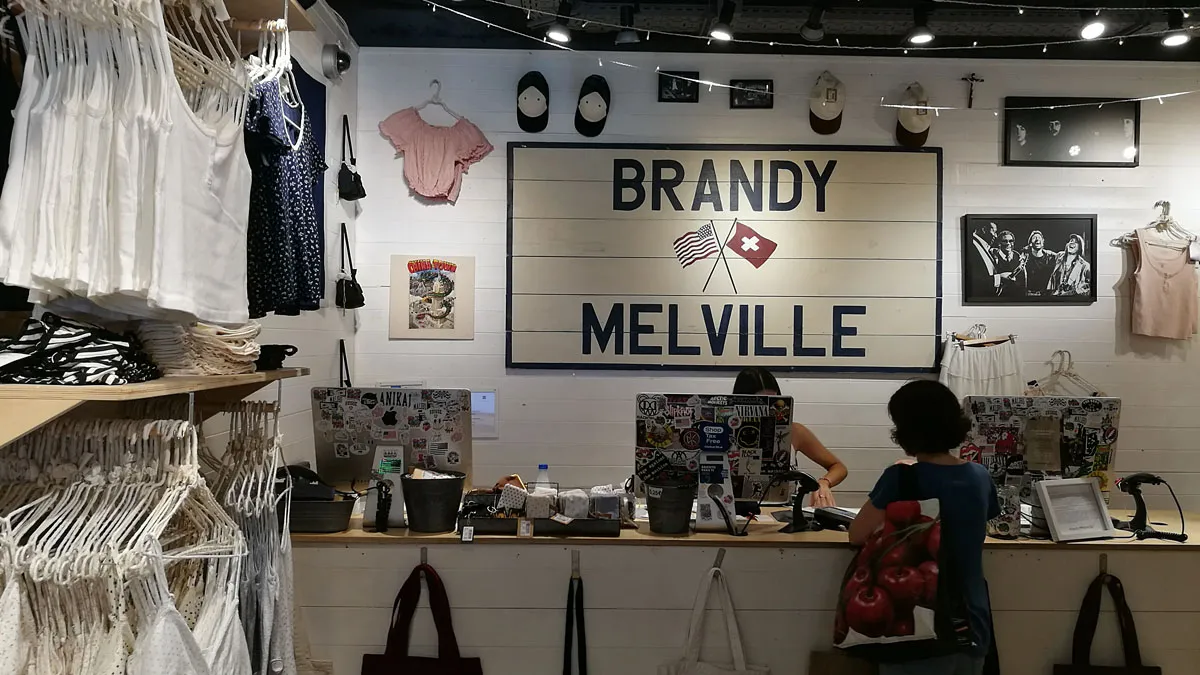
Is Brandy Melville closing its fitting rooms for good? The teen favorite courted controversy once again last week, when customers across the US, the UK, and Canada took to social media to share photos and videos of seemingly shuttered in-store fitting rooms. Users purporting to be staff confirmed this, with videos of them disassembling the fitting rooms and confirming the closures.
Online, the alleged closures have been attributed to everything from “the gum issue” (customers reportedly using chewing gum to stick the curtain to the wall for privacy) to vandalism, and renovation. The backlash has been swift, and fierce. “Why does Brandy hate [its] customers?” one TikTok user asked. “Very interesting policy update from a company with notoriously difficult sizing,” commented another, referencing the brand’s one-size-fits-all policy, which generally translates to an XS-S size range, despite general consumer demand for more inclusive sizing. Brandy Melville also does not accept returns, taking goods back for exchange only, a factor that has added fuel to the furor. The company has not confirmed the closures, and did not respond to requests for comment from Vogue Business.
Brandy Melville, which was founded in Italy but trades on a laidback California-inspired aesthetic, would join a growing list of stores closing fitting rooms, including UK supermarkets Sainsbury’s and Tesco (which sell clothes under brands Tu and F&F, respectively) and US thrift chain Goodwill.
Each Goodwill region operates independently, so communications on the matter have varied from local Facebook posts and in-store signage to online statements. In a fitting room FAQs section on its website, Goodwill’s Valleys region (which serves central, southwest, and south Virginia) said: “Keeping fitting rooms open, and maintained, requires additional staffing and expenses that we are not equipped to manage. Diverting our staffing resources away from fitting room maintenance allows us to focus on a quality shopping experience and allows our retail teams to focus on tasks such as stocking the sales floor with premium items.” Certain Goodwill locations have highlighted theft as a further driver for fitting room closures. It’s a reason highlighted by many charity retailers, often staffed by a patchwork of volunteers ill-equipped to deal with it.
Meanwhile, Sainsbury’s wrote on X in February 2025 that its closures were designed to “simplify and reduce tasks in stores”.
The closures come during a difficult period for in-store retail. In 2025 alone, the failure of 57 major businesses impacted 3,384 stores and 32,553 employees in the UK, per the Center of Retail Research. US retailers, meanwhile, shuttered over 8,200 stores in 2025, a 12% year-on-year increase from 2024 and one of the highest numbers ever recorded, according to retail research firm Coresight Research. When times are tough, brands are quick to identify ways to cut the fat, and space comes at a premium. But while there could be short-term financial gains to be made from closing fitting rooms such as cutting operational costs and maximizing floor space, experts say the move could be detrimental to sustainability and long-term profitability.
What about the customer experience?
Many Brandy Melville shoppers are already signaling their intentions to boycott the brand’s own stores. “If I can’t try it on, I’m not buying it,” said one commenter, while others have been encouraging fellow shoppers to go to US retailer Pacsun, which stocks Brandy Melville, if they want to try on, swapping direct retail for wholesale, which could cut margins by up to half.
