

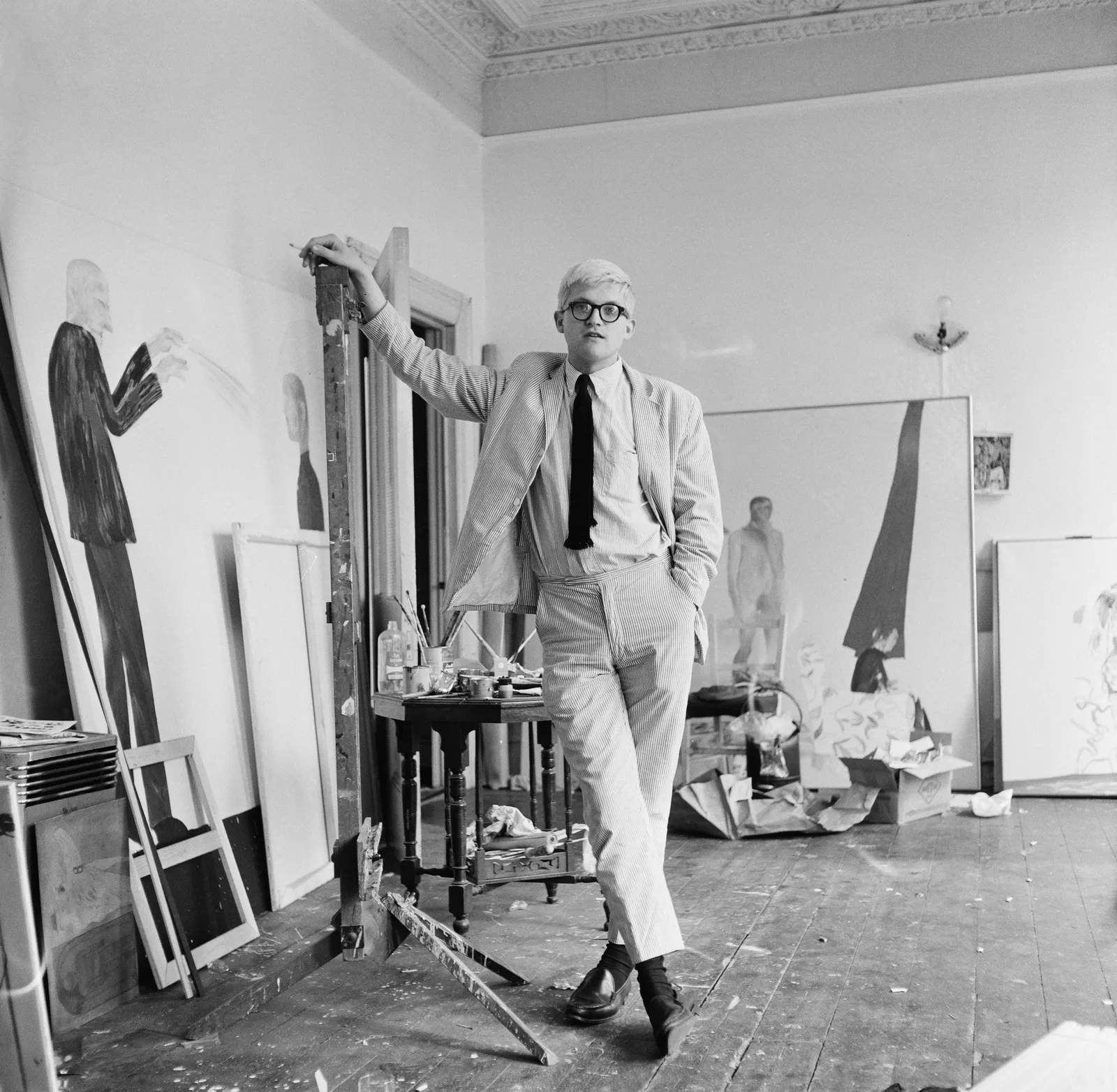
David Hockney’s first solo show, which opened in London in 1963, was Pictures With People In, a defiantly figurative title for the poster boy of a new and challenging school of painting, Pop Art. He had recently left the Royal College of Art and nearly without his degree, for refusing to draw a nude from life—a requirement—but in the end they awarded him a gold medal.
That year also saw Hockney’s first appearance in Vogue, a group portrait with fellow painters Howard Hodgkin, John Howlin, and Ian Stephenson. Vogue called them “The Impact Makers.” Three of the four arrived soberly dressed, one of them, Hodgkin, in a black suit, folded his arms and stared glumly ahead. Stephenson and Howlin looked equally ill at ease. Only Hockney, standing apart from the others, appeared unperturbed. Already blond-haired care of “Champagne Ice”—“You see, I came home slightly drunk one evening and saw an advertisement on TV which said that blonds have more fun”—his raffish personal style set him further apart: a pale-blue seersucker blazer and fuchsia-pink tie. And then there were those emblematic, owlish spectacles with rims as large as bicycle wheels.

Hockney, born in Bradford in 1937, was the second youngest and the most famous of the four, the most used to being photographed, the most publicly lauded. Just ahead of him lay California, its swimming pools and “A Bigger Splash,” and later on opera and stage sets, “Mr and Mrs Clark and Percy,” Stanley the dachshund, multi-print Polaroid film collages, and research into the properties of lenticular devices, eye-boggling iPad pictures, and late-in-life “fully immersive” exhibitions. But for now, he leaned on a large canvas, insouciantly smoking a cigarette.
In 1964, he decamped to Los Angeles. “I used to think London was exciting,” he explained, “Well, it is compared to Bradford; but compared with New York or San Francisco, it’s nothing.” But London would not let him go so easily. He found himself part of its cultural elite, a leading player in “Swinging London”—no matter that he was on the far side of the world. Still, for all his time on America’s West Coast he never lost his Northern accent, which made him almost unintelligible to Vogue’s Cecil Beaton, but as his friend and contemporary RB Kitaj observed: “Northern England is his native strength—and he knows it.”

