

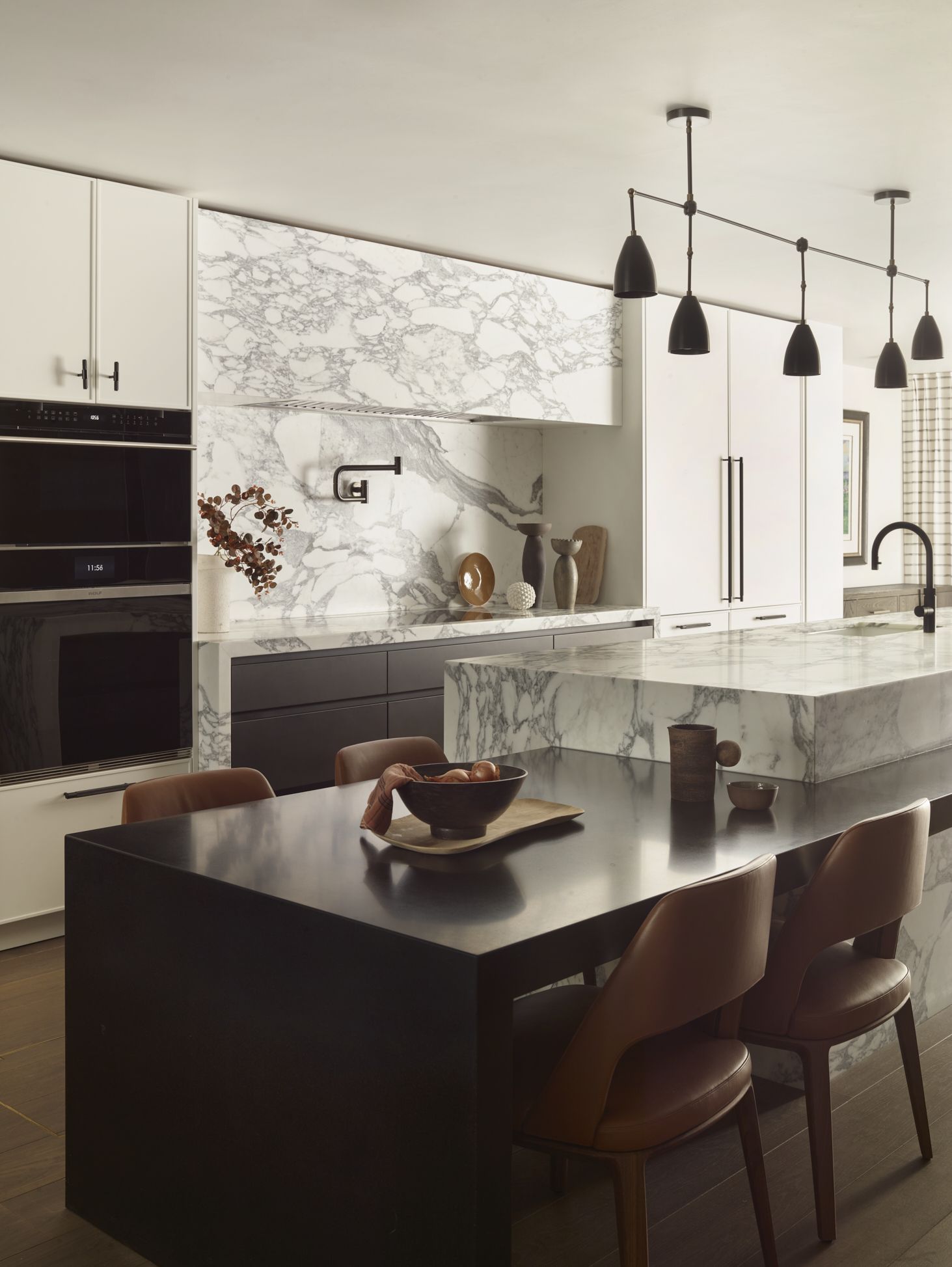
If you’re planning a kitchen renovation, you’ve likely already fallen down the rabbit hole of the dreaded kitchen triangle debate. For some, it’s an absolute essential. The non-debatable backbone to every good kitchen design. And to others, it’s an outdated, overrated old wives’ tale — a rule that should’ve been abandoned long ago.
It can all get rather heated, not to mention thoroughly overwhelming for someone simply trying to find the best layout for them. At the crux of the matter, though, is not the concept of the ‘working triangle’ itself, but how exactly you do it. Because, despite how fervently people protest against it, there’s a reason this layout has been sworn by for so many years. It introduces logic and flow into your kitchen, and so long as you know the mistakes to avoid, it can be the key to a functional and well-designed space.
But before we can dive into the kitchen work triangle mistakes people are making, let’s outline what exactly the term means. “The working triangle is a classic kitchen planning principle that positions the sink, hob and refrigerator within easy reach of one another, creating an efficient route between the three most frequently used areas,” explains Claire Watson from Harvey Jones. “While kitchens have evolved considerably, the principle remains relevant because it helps reduce unnecessary movement and creates a more intuitive cooking experience. Designed to flow with real routines, the kitchen feels effortless to use, whether you’re preparing a quick breakfast or hosting family and friends.” And with that, these are the five mistakes you might be making and how to fix them.

1. The Points Are Too Far Apart

DO INSTEAD: Map out how you’ll use your space before you commit to the design; try walking around and figuring out the optimum distances for you.
(Image credit: Harvey Jones)
Now, this may not be the most relevant for those with small kitchens, but for larger spaces, it’s not always a case of ‘the more room, the better’.
As Claire explains, “A common mistake is placing the three points too far apart, which can make the kitchen feel disconnected.”
When you have plenty of space to work with, it can be hard to know how to use it. It may seem as though it should be easier to design a larger room than a smaller one, but in kitchens, it can often go the other way, and to use up the available space, people end up leaving huge gaps between each of the three elements, rendering the ‘triangle’ essentially useless.
The whole point of this type of kitchen layout is that it introduces a logical flow to your cooking process — the three elements work in circularity, acting as parts of a whole. However, once too much space is introduced between the three, this sense of flow ceases to exist, making your kitchen feel even more awkward to use.
2. Poor Appliance Placement

DO INSTEAD: Make sure both your fridge and oven doors can be fully opened at the same time, without intersecting with one another.
(Image credit: Roundhouse)
Knowing where to position your kitchen appliances is an oft-underestimated aspect of designing a kitchen — it will affect not just how your space looks, but how you use it, too. The wrong appliance placement can throw off the whole flow of your kitchen, especially when it interacts with your working triangle.
Ethan Greenfeld, from Ethan Charles Design, says this is one of the most common mistakes he sees. More often than not, he says, this takes the form of appliances intersecting with the primary walkways of your kitchen.
Describing why this is such a problem, Ethan says, “While you’re cooking, it is best to be away from the main traffic of the kitchen, if possible. Imagine having to take something out of the oven while someone has to squeeze behind you to get to the refrigerator, all while the oven door is open. That is neither the safest nor the most efficient setup.”
Your appliances should be spaced apart so that all can be used at the same time, if needed, without causing any issues.
3. Forgetting About Prep Space

DO INSTEAD: “Once you have planned the kitchen out, double-check you have at least one working area in an orientation you enjoy; if you don’t, do some reworking so you do,” says Michelle.
(Image credit: Stacy Goldberg. Project: Zoe Feldman.)
In theory, the kitchen triangle should account for the majority of your kitchen needs. You’ve got the oven, fridge, and sink all ticked off, luring you into a false sense of security in your layout. There is, however, one crucial aspect missing: prep space.
Without adequate prep space, your kitchen will constantly feel overflowing with mess, and every dinner will feel like a battle for surface space.
In fact, prep space is so crucial that designer Michelle Accetta argues, “If the triangle were a square, this would be the fourth leg!”
It’s all too easy for your kitchen worktop to become cluttered, with space needed for your appliances and all-important decor pieces, too. So much so that once all your kitchen finishing touches are in place, there is often barely any space left for a prep area.
“Some kitchens I see chop up the counter space so there is not one area with ample space to do all your chopping and prep,” notes Michelle. But having a dedicated prep space doesn’t detract from the triangle; it supports it, allowing it to function at its best.
4. Awkward Islands

DO INSTEAD: Treat your island as a part of the triangle, and position it to work alongside the other three features.
(Image credit: Beth Davis. Design: Holte.)
Perhaps the most common mistake of all, designers say, is the issue of the kitchen island. Instead of being used to support the triangle, islands are often placed smack bang in the middle, completely blocking the flow of movement between the three points.
Your kitchen island will play a key role in your kitchen design, no matter the layout. It acts as a central hub for activity in the room, offering an anchor for people to gather around, but because of this, it can easily dominate the space, overwhelming your design and interrupting the all-important working triangle.
Once an island is placed in between the triangle, it becomes a hindrance rather than a help, and your kitchen will likely suffer because of it.
5. Forcing Flow, Not Following It

DO INSTEAD: Design your working triangle to reflect your personal needs.
(Image credit: Mary Wadsworth. Roundhouse)
The whole point of the kitchen working triangle is that it should make your life easier, so if at any point you feel as though it’s making your modern kitchen harder to use, you’ve already made a mistake.
It doesn’t have to be a one-size-fits-all design; the working triangle should look different depending on whose home it’s being used in, so feel free to adapt and alter the design to best support your specific space and needs.
“Rather than treating the working triangle as a rigid rule, it should be interpreted into a bespoke layout to suit the space and lifestyle of the homeowner,” says Claire. To get it right, she says, “Ensure there is a clear route between the key zones, while also allowing enough room for multiple people to use the kitchen comfortably.”

GreenWhim
Bamboo Cutting Board Stove Cover With Juice Groove
Too late to add in more prep space? This chopping board can save you, transforming your hob into a handy chopping board.

Dunelm
Black Smart Industrial Corner Storage Rack
The more countertop space you can free up, the better your working triangle will work, and this clever storage rack keeps your clutter all in one space, and off your worktop.

TOAST
Cortona Stripe Utensil Jar
Make your working triangle even more efficient and keep all your utensils right where you need them with this lovely stripy holder.
Making mistakes with the working triangle isn’t the only thing that could be making your space harder to use — these small kitchen layout mistakes are what designers say you need to avoid to ensure you make the most of your compact footprint.
And for the rest of your design inspiration, subscribe to our newsletter, and all the latest will be delivered directly to your inbox.
