

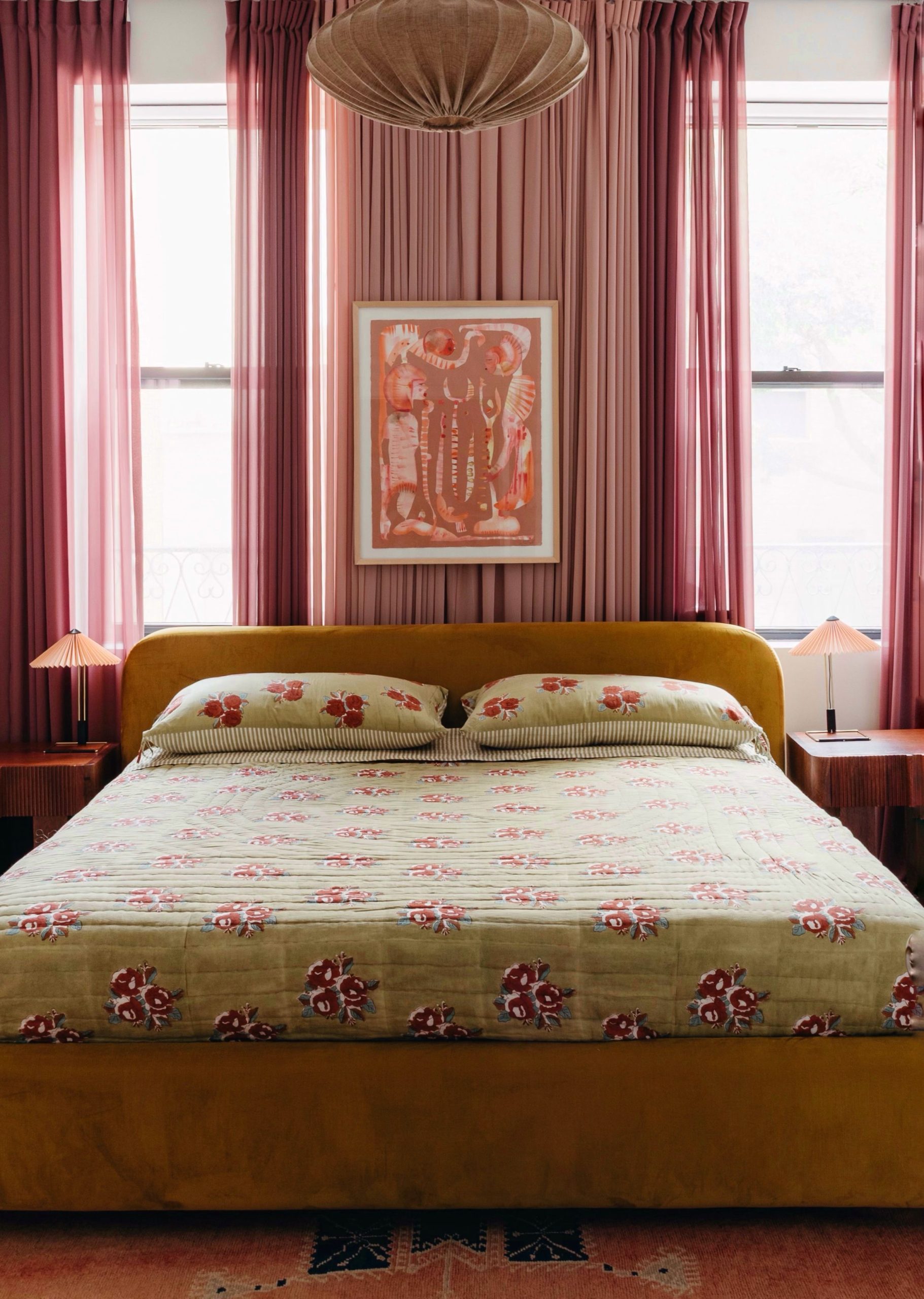
Bedroom curtain trends have traditionally satisfied two main requirements: block light and provide privacy. But beyond those chief concerns, interior designers have lately asked more of them — the most exciting bedroom curtain trends, in fact, have little to do with windows at all.
“I think we’re increasingly treating drapery as soft architecture rather than simply window dressings,” agrees interior designer Alyssa Owens. “It can disguise awkward conditions, create focal points, introduce color and texture, and transform a room — in a bedroom, where atmosphere is everything, that influence is hard to overstate.”
Increasingly, curtain trends are migrating from windows and stretching across entire walls or surrounding beds; they are acting as decorative devices that frame artwork or even replace wallpaper. Function hasn’t been abandoned (blackout curtains are still essential in an era of ‘sleep-maxxing’), but designers are expanding the category entirely, turning the usually straightforward curtain into a standout design moment.
“As bedrooms have become more of a retreat from increasingly busy lives, every layer matters,” says interior designer David Ries. “Curtains can be both practical and deeply expressive, so I think people are paying much closer attention to them than they did even a decade ago.” Below, designers highlight the bedroom curtain trends they’re most excited about this year.

1. Wall-to-Wall Pleats

Perfect for bedrooms with odd window configurations, wall-to-wall curtains create a soft, cocooning look.
(Image credit: Sean Litchfield. Design: Nest Studio)
We tend to think of curtains for windows. But you might consider them for your walls instead: designers increasingly bypass the panes entirely for wall-to-wall drapes that bring a ‘cocooning effect’ to the bedroom.
For Jessica Davis, principal and creative director of Nest Studio, this approach creates a seamless visual effect. “They soften a space and add a uniformity that traditional drapes don’t have,” she says. “If you have a bunch of windows and each one has a separate treatment, it can look choppy and busy.”
In a recent project, Jessica leaned into the sumptuous effect with a gauzy curtain fabric that’s atmospheric, running the drape behind the headboard, enveloping the bedroom. By installing the track as close to the bedroom ceiling as possible, it becomes less decorative and more architectural. “You want the track to be unobtrusive and blend with the wall or ceiling color versus standing out, which is often the case with traditional window treatments,” she explains.
The pleat itself matters, too. “You should also use a ripple-fold type of pleat instead of a traditional pinch pleat — it looks much cleaner and works better with this type of application,” Jessica adds.
2. Artistic Backdrops

When it comes to hanging art like a designer, have you ever considered a curtain backdrop?
(Image credit: Kathleen Fitzgerald of Two Studios. Design: Alyssa Owens)
You can think of drapery as a way to block light, but designers are using curtains more like a backdrop, too. Branching off the trend for wall-to-wall curtains, some are now suspending framed artworks against drapery to create a striking and ‘floating’ focal point above the bed.
“Using drapery as a backdrop creates opportunities for art where there might otherwise be none,” says Alyssa Owens, who recently hung a Mary Ball painting against sheer chiffon curtains. “In this project, it helped us solve several problems at once: disguising asymmetrical windows, creating a focal point above the bed, and making the room feel more atmospheric and restful without any permanent alterations.”
Achieving the seamless look requires some technical prowess. In Alyssa’s case, her team mounted a timber block to the wall just behind the drapery so the artwork would hang flush with the fabric. “Curtain fullness, track location, artwork size, and projection all need to be considered together,” she says. “I’ve also seen beautiful examples using wires or ceiling-mounted systems.”
The choice of fabric is equally important. Structured drapery with generous folds, she says, can lend a more formal, gallery-like quality, while lighter textiles do the opposite. “The goal was softness and immersion, so we intentionally selected a lightweight chiffon sheer,” she says. “The sheer curtains diffuse light, soften the edges of the room, and allow the artwork to sit within a cloud of color.”
The result can transform not only the room, but the artwork itself. “When an artwork sits among folds of fabric rather than against a hard surface, the whole arrangement is softer and more enveloping,” she adds.

H&M
Curtain Lengths in Dusty Pink, Set of 2
While you can opt for a thicker fabric to get a more structural backdrop, this lightweight sheer creates a soothing, atmospheric backdrop — its subtle rosy tint also allows you to float a bolder artwork in front of the folds, acting almost like a neutral.

Alyssa Owens is a Melbourne-based interior designer who draws on formative years in New Orleans and its elective spirit throughout her work. There’s a curatorial energy to her homes, often with a keen sense for art and color, not to mention vintage and contemporary furnishing that all blend together to create sophisticated, atmospheric spaces.
3. Cocooning Canopies

That winning combination — gauzy sheer and solid fabric — also lifts the traditional-leaning four-poster into the present. The pairing, says Christopher, “helps keep the bed hangings feeling light and airy rather than heavy or imposing.”
(Image credit: Pär Bengtsson. Design: Christopher Alexander)
Who says bedroom curtains are just for windows? Reimagining a centuries-old decorating device, designers are once again embracing curtains around canopy beds, often coordinating them with window treatments to create a fabric-drenched effect.
For interior designer Christopher Alexander, the appeal is about more than aesthetics. “Bed hangings are an effective way to temper the scale of a room,” he says. “As bedrooms have grown increasingly large, they can often feel expansive and impersonal.”
In a recent project, Christopher chose a sheer Zak + Fox fabric for both the bed hangings and window treatments within an oversized primary suite. “The addition of bed hangings helps visually reduce that volume, creating a greater sense of intimacy and comfort,” he explains. “Beyond their decorative appeal, fabric introduces softness, texture, and a subtle architectural division within the space, making the room feel more layered and inviting.”
To give the scheme a contemporary edge, Christopher opted for a double-sided treatment with a jolt of color: he paired the neutral sheer with an eye-catching magenta Donghia fabric on the interior-facing panels. “The central color block on the interior panels draws you in and provides a point of interest, yet it never disrupts the serenity of the space,” he says. “Instead, it adds depth, focus, and a subtle layer of visual engagement.”

Anthropologie
Roma Canopy Bed
Canopy beds with curtains instantly create a strong focal point in the room — but with the right fabric, they can also soften the entire look and give the bedroom a cozy, cocooning atmosphere.
4. Retro Shorties

In the long vs short curtain debate, there’s something refreshing about a cropped cut.
(Image credit: Josh Grubbs. Design: Heather Peterson Design)
We’ve seen plenty of interiors with drapes that reach all the way to the floor — and even drapes that puddle dramatically — but interior designer Heather Peterson is making the case for hiking up the hem, particularly in more relaxed bedrooms.
“In casual settings, we’re digging the return of shorty curtains,” she says. “After years of debate over hems pooling or just ‘kissing’ the floor, there’s something refreshingly retro about a short hem.”
In this lakehouse bedroom, Heather paired rough-sawn board-and-batten walls with curtains in Amy Karyn’s vintage-inspired ‘Camille’ fabric, cut to land just below the window trim. “The odd length keeps the curtains from getting too sweet,” she explains. “The trick is to use a crisp construction to make sure retro does not tip into just plain old.”
The margins are rather fine, which means getting the proportions right is essential. “I would think about the space between the bottom of the window and the floor in thirds, and keep the hem in the top third,” she says. “In this bedroom, we have nearly equal spacing above and below the window, which also feels practiced and intentional.” As a rule of thumb, she approaches short curtains much as she would a Roman shade, allowing them to just cover the bottom of the trim.
As for fabrics, Heather recommends sticking to natural and easy textiles like cotton, linen, and chintz, provided they have enough body to their shape. “Something too soft or sheer is going to feel saggy, and suddenly the treatment is like something out of a dated motel,” she warns.

Heather Peterson is a Minneapolis-based interior designer with a knack for mixing classic architecture with contemporary flair. A former magazine photo editor and a Columbia University-trained curator, her layered schemes often feature confident pops of color and pattern, and she prides herself in designing homes that allow her clients personalities to shine through.
5. Maximal Meets Minimal

“It’s maximalism with intention: one expressive gesture supported by quieter surrounding elements,” says David.
(Image credit: Joshua McHugh)
Clients aren’t always brave when it comes to their bedroom design. Many seek out calming, neutral bedroom schemes even if the rest of the house has a bit more energy. But New York’s Ries Hayes studio thinks there’s another way to find balance: maximalist curtains.
“Statement curtains allow you to introduce visual interest at the perimeter of the room while keeping the primary experience — your bed, bedding, lighting, and circulation — serene and uncluttered,” says the studio’s co-founder, David Ries. He put this into action with black-and-ivory botanical drapery in an otherwise disciplined bedroom scheme, offering lively contrast with clean-lined furnishings and a restrained palette of warm walnut tones.
“The drapes frame the expansive view while adding movement and a sense of personality, but the neutral palette keeps the look sophisticated,” he adds.
To keep patterned curtains from feeling too dominant, David recommends restraint and proportion. “Often that means limiting the palette, even if the pattern itself is bold,” he says. “In bedrooms especially, I gravitate toward motifs inspired by nature — botanicals, abstract organic forms, or geometric patterns with some softness to them.”
And even busy patterns can be quelled with the right fabric choice. “Linen blends, cottons, and textured weaves diffuse light beautifully and introduce softness, whereas overly shiny fabrics can sometimes feel too formal or energetic for a space meant for rest,” he adds.

HÖEM
Carro Abstract Eyelet Curtains
The pattern itself is busy and bold, but the organic shapes and soft geometry reign in the look of this curtain. The cotton fabric also softens the effect, allowing it to live comfortably amongst restrained schemes.
The good news is that drapes don’t have to be expensive to look expensive; it’s about knowing where to shop for curtains with a designer look and how to hang them in the most interesting ways — and now you do.
For more inspiration, subscribe to Livingetc’s newsletter.
