

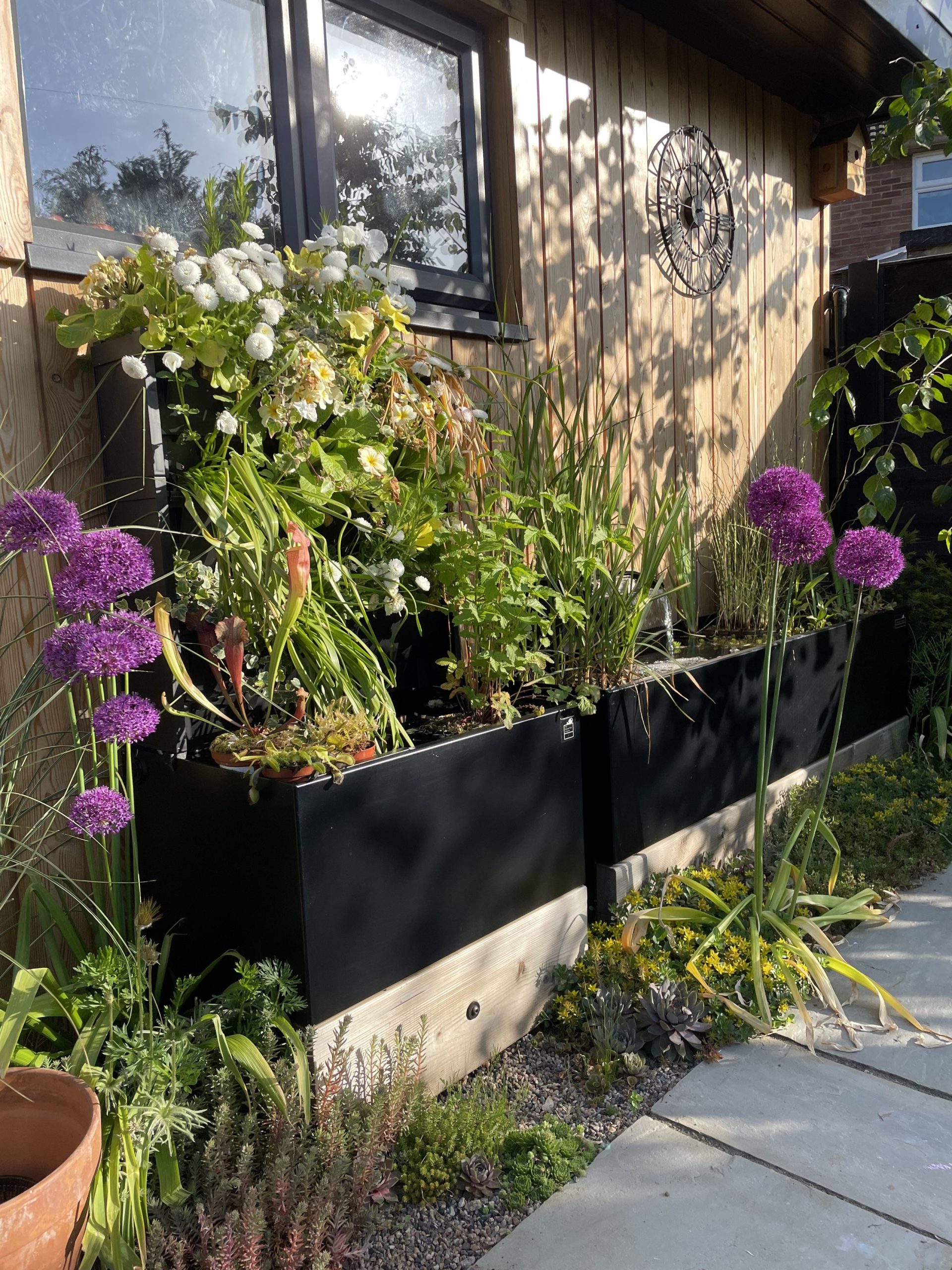
Rainwater harvesting has long been viewed as a purely practical garden necessity, something slightly unattractive to hide behind a shed or tuck beside the hosepipe. But a growing number of landscape designers are rethinking that idea entirely through the rise of the ‘dipping tank’, a useful feature that has the potential to double as a sculptural water element when styled correctly.
Traditionally used on farms, allotments, and in kitchen gardens as open reservoirs for collecting rainwater, dipping tanks are now appearing in contemporary outdoor spaces as a more stylish alternative to standard water butts. With weathered finishes, reflective surfaces, and a wildlife-friendly appeal, they can make a sustainable design feel beautiful rather than just functional, and bring this element to a water garden.
Landscape designer Mandy Buckland of Green Cube Design has increasingly been incorporating dipping tanks into her projects as both visual focal points and practical rainwater harvesting systems. “People are increasingly looking for gardens that feel calming, naturalistic, and environmentally conscious,” she says. “A dipping tank can quietly do all three.”

Mandy Buckland
Amanda Buckland is a member of the Society of Garden Designers (SGD) and has been awarded Gold Medals at RHS Chelsea and RHS Hampton Court. She personally works with every client at Green Cube Design, understanding their brief, designing their garden, liaising with landscapers, developing planting plans, sourcing plants and overseeing planting works.
What Is a Dipping Tank?

Image credit: Green Cube Design

Image credit: Green Cube Design
“At its simplest, it’s a vessel that collects and harvests rainwater much like a water butt,” explains Mandy, “but it looks beautiful and allows easy, quick access to fill a watering can simply by dipping.”
Unlike enclosed water butts, dipping tanks are typically open, shallow, and wide, allowing rainwater to collect directly from roofs, chains, gutters, or surrounding hardscaping. Historically, gardeners would literally dip watering cans into the reservoir, which is where the name originates.
Today, designers are revisiting the concept through a more aesthetic lens, often specifying corten steel troughs, zinc basins, reclaimed livestock tanks, or stone vessels that feel intentionally integrated into the landscape.
What makes dipping tanks especially appealing is how they are both a sustainability feature and an ornamental water feature. They can reflect the surrounding planting and sky beautifully, support aquatic life, and introduce texture into a garden without requiring the scale or infrastructure of a formal pond.
“Even in a very contemporary garden, visible water softens the space and makes it feel more connected to nature,” Mandy says.
Why Are Dipping Tanks Becoming So Popular?

The Dipping Tank Company offers readymade and bespoke styles.
(Image credit: The Dipping Tank Company)
Part of the growing appeal comes down to creating a climate-resilient garden. “This is our second dry spring,” says Mandy. “Climate patterns are changing, we’re seeing wet winters and much drier springs and summers.”
As gardeners become increasingly conscious of water conservation, rainwater harvesting is becoming less of a niche sustainability measure and more of a necessity. Dipping tanks offer a more elegant way to approach it.
“Reducing the use of metered mains water is a huge factor,” Mandy explains. “Rainwater is also much better pH-balanced for plants.”
In Mandy’s own projects, rainwater is often diverted directly from a greenhouse or garden building roof into a steel trough below. “The steel trough collects the water and makes it easy to dip a watering can in for quick access,” she says. “We also install an overflow pipe close to the top, so when the tank fills, excess water flows into a leaky hose that slowly irrigates nearby hedging.”
This creates a system that feels sustainable and visually integrated into the garden rather than hidden away.
How to Style Dipping Tanks in Your Garden

Filling a dipping tank with aquatic plants can make it a focal point of your planting scheme, too.
(Image credit: The Dipping Tank Company)
One reason designers love dipping tanks is their versatility. They can work equally well in rustic cottage gardens, minimalist courtyard gardens, or larger contemporary landscapes.
Position Them Carefully
Placement is one of the most important considerations. “The tanks in our schemes feel sculptural because of placement and the way we soften them with planting,” says Mandy.
Because water naturally reflects light and the surrounding greenery, designers often position dipping tanks where they can mirror nearby trees, grasses, or evening sun. Near a seating area, they can create a calming focal point that changes throughout the day.
Pair Them With Soft Planting
Naturalistic planting helps dipping tanks feel embedded into the landscape rather than dropped into it.
Mandy often places them beside greenhouses so collected rainwater can be used directly for seedlings and tender plants. Around the tanks themselves, moisture-loving planting creates a softer feel.
Some of her favourite aquatic plants include: Pontederia cordata, Nymphaea tetragona, Ranunculus aquatilis, Hottonia palustris, Ceratophyllum demersum and Iris pseudacorus. “These aquatic plants help create a microclimate and a self-sustaining ecosystem,” Mandy explains. “They also naturally help prevent algae growth.”
Think About Materiality
Material choice makes a huge difference to the final effect. Mandy gravitates toward steel tanks, which develop a weathered patina over time and sit naturally alongside surrounding planting.
Corten steel is particularly popular in contemporary gardens thanks to its rich rusted finish, while galvanized steel offers a softer, more traditional feel. Reclaimed stone troughs, meanwhile, work beautifully in rustic or cottage-style spaces.
They Work in Small Gardens Too
Although dipping tanks often appear in larger landscape projects, Mandy says they can absolutely work in compact urban gardens too. “You could simply use a bowl or large pot in a smaller garden,” she says. “It doesn’t have to be a huge feature.”Even a modest water vessel can introduce reflection, movement, and biodiversity into a small outdoor space while still collecting rainwater naturally.

LuxUnique
Corten Steel Water Trough

Clarkes of Walsham
Galvanised Cattle Drinking Trough

The Dipping Tank Company
2m Dipping Tank – Treated Timber / No Kit
The growing popularity of dipping tanks reflects a much broader shift in how gardens are being designed in response to climate and sustainability concerns.
“Adapting to extreme weather patterns and conserving rainwater is becoming increasingly important,” she says. “Diverting rainwater into a dipping tank is a sustainable, natural way to harvest and reuse water.”
Unlike purely practical garden infrastructure, dipping tanks prove that environmentally conscious design doesn’t have to compromise on beauty. In fact, it can be the feature that defines it.
For more inspiration for your garden this year, why not sign up to the Livingetc newsletter?
