

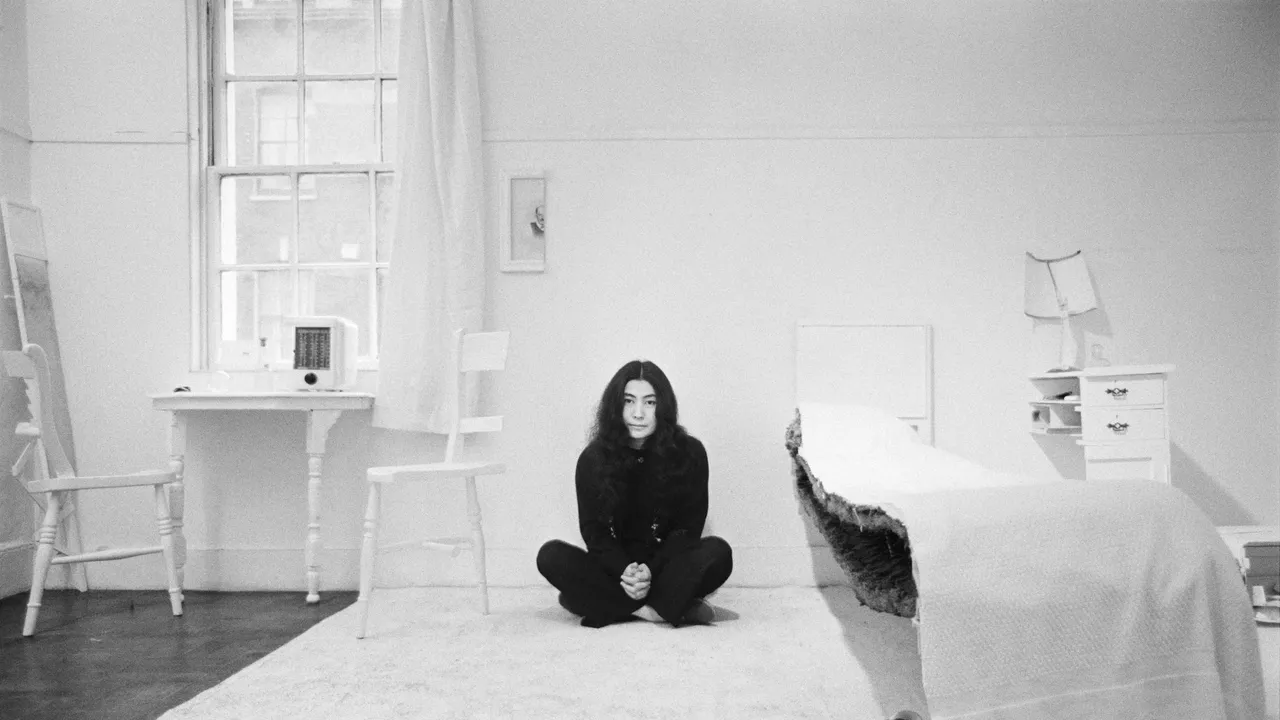
In 1971, Yoko Ono placed ads in local newspapers announcing a one-woman exhibition at New York’s Museum of Modern Art. When visitors arrived for the exhibit, however, they encountered a small sign outside the entrance. It explained that Ono had released flies onto the museum grounds—and invited the public to follow them through the city. There was, in the end, no sanctioned exhibition inside; instead, Ono stationed cameramen around the building’s perimeter to ask visitors what they thought of the show.
Their reactions became the artwork itself. While some people performatively raved about the nonexistent exhibition, others immediately began trying to decode what it all meant. Many dismissed Ono outright, with one person calling her “bonkers.” But in the grainy footage documenting the intervention, one viewer responds with pure delight: a child. When the interviewer asks what he would think if the exhibition existed only in his imagination, the boy breaks into a grin. “Then you have a very good museum there,” he says. “That’s real neato.”
That clip now plays inside “Yoko Ono: Music of the Mind” at The Broad in Los Angeles, where it functions less like archival footage than as a key to understanding Ono’s entire practice. Running through October 11, “Music of the Mind” is the artist, musician, and activist’s first solo museum exhibition in Southern California and surveys much of Ono’s early work, spanning conceptual art, music, film, installation, instruction pieces, and activism.
“Yoko has a very large universe of work that’s not represented in the show, and couldn’t be,” says her studio director of nearly two decades, Connor Monahan. “There’s no one show that could really encompass all of Yoko’s work.”
The show at the Broad arrives amid a cultural reframing of Ono’s legacy. Long dismissed by the public as either an absurd avant-garde provocateur or simply “the woman who broke up The Beatles,” Ono is now widely understood to be one of the foundational figures of conceptual and performance art. “Music of the Mind” underscores that, positioning Ono not as a cultural footnote or curiosity, but as one of the defining artistic visionaries of the last century.
“There’s a relentless optimism with Yoko,” says Monahan. “Many people, if they received that kind of public criticism, wouldn’t continue to make more work. But she was never broken by that.” He points to one of Ono’s longtime philosophies: “Believe in yourself and you’ll change the world.”
“Imagination is not secondary to the work; it is the work,” Monahan adds—an idea that the child outside MoMA instinctively embraced.
Ono’s understanding of imagination as nourishment began early. At 12 years old, after being evacuated from Tokyo during World War II, she and her family took refuge in the Japanese countryside. Food was scarce there, so Ono and her younger brother Keisuke would lie on their backs, looking up at the sky and exchanging “menus in the air”—imagining elaborate meals together. Sarah Loyer, curator and exhibitions manager at The Broad, describes those moments as “a belief in one’s imagination as a mode of survival.” Ono later considered her fantasized feasts among her first works of art.
After returning to Tokyo, Ono enrolled at Gakushuin University in 1952, becoming the school’s first female philosophy student before moving to the United States in 1953 and attending Sarah Lawrence College, where she studied poetry and musical composition.
By the early 1960s, Ono had become deeply embedded in New York’s downtown avant-garde scene, staging experimental performances and instruction-based works out of her Chambers Street loft and piquing the curiosity of figures such as Marcel Duchamp, Peggy Guggenheim, Isamu Noguchi, and Robert Rauschenberg.
