

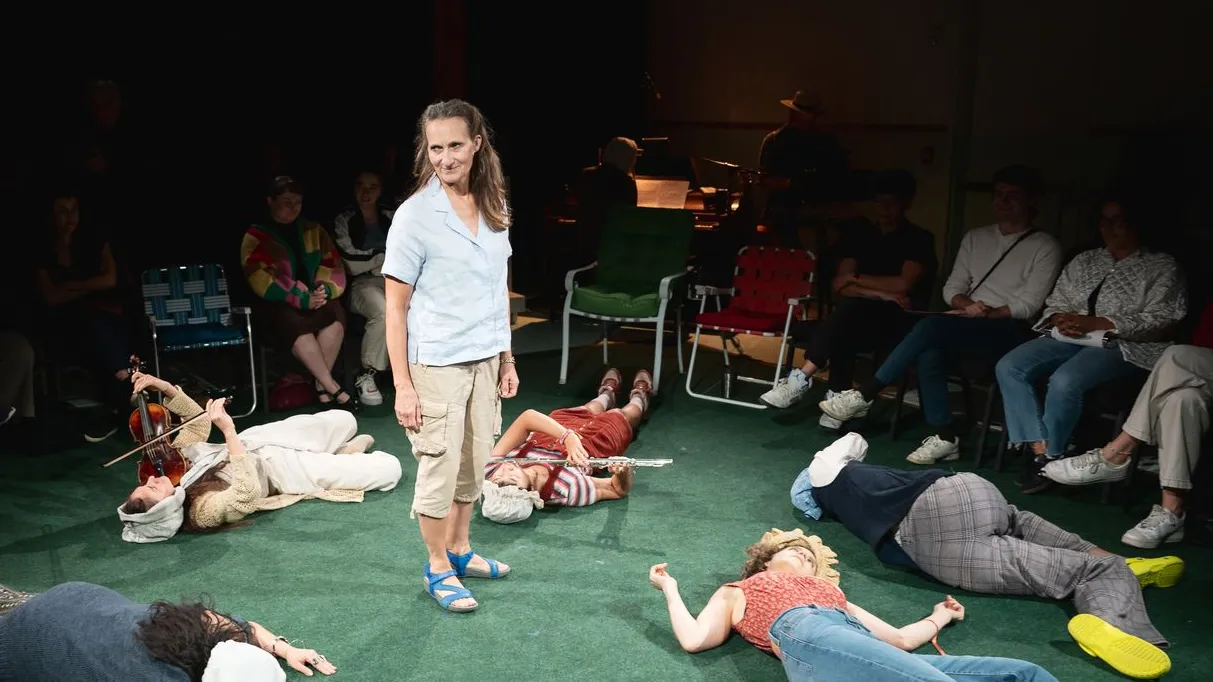
In the first stage directions for All My Sons, Arthur Miller establishes the lead of his 1947 play—the folksy, respected factory owner Joe Keller—as “a man among men.” You can picture the Pulitzer winner ashing his pipe while writing it, and any number of men nodding in recognition as they read it: An all-American salt of the earth type, see?
While the writer Julia May Jonas doesn’t go for the kind of lengthy preamble that Miller used to set the scene, that description guided her riff on Miller’s classic, the cheekily titled A Woman Among Women.
What it might look like for a woman to be considered a pillar of the community, Jonas wondered? Her answer is currently in performance at Lincoln Center Theater after a well-received premiere at the Bushwick Starr in 2024.
Woman is the first in a five-play cycle reimagining landmarks of the American canon, developed in part with the director Sarah Catherine Hughes. The series, collectively titled All Long True American Stories, also tackles Eugene O’Neill’s Long Day’s Journey into Night, Sam Shepard’s True West, David Mamet’s American Buffalo, and Edward Albee’s The Zoo Story. “You do one, who cares?” Jonas deadpans. “But if you do five, you’re trying to really discover something.”
As Hughes explains, the project is intended to be additive to the canon, neither takedown nor translation. Jonas arrived at these plays intuitively; they were the first five she thought of, and her responses were an amalgamation of what first came to mind when thinking of them and what she was already interested in doing, artistically (and some irreverence). Her take on Long Day’s Journey, for example, We Used To Wear Bonnets & Get High All The Time, is not so much about one family’s evening at home, but about a century’s worth of generations who have occupied the same house.
Still, the space those source plays occupy is inescapable. Jonas recalls browsing Powell’s Books, a large independent shop in Portland, Oregon, and noticing its drama section pretty much only included these writers’ works. It mostly plays out the same in actual theaters: In 2020, as Hughes and Jonas were preparing to begin rolling out the cycle at the Starr, before the pandemic derailed their plans, each entry’s inspiration had received major New York revivals within a year.
But enough about the past. Joe Keller’s come and gone, and Jonas has given us Cleo, a sixty-something therapist who runs a women’s wellness center in Northampton, MA. Though preserving Miller’s central themes of truth and personal responsibility—can a pillar of the community turn into a pillar of salt?—the drama shifts from a post-war story about the sale of faulty aircraft parts to explore dynamics of care (self and communal) among women. Cleo’s daughter, Jo, was involved in an altercation that landed her in jail. As the play progresses, details emerge about the factors which may have contributed to Jo’s aggression, echoing themes of nature versus nurture—and the intersection with mental illness, medication, and agency.
.jpg)
Actor Hannah Heller and writer Julia May Jonas at a rehearsal for A Woman Among Women.photo: Laurel Hinton / courtesy Lincoln Center Theater
