

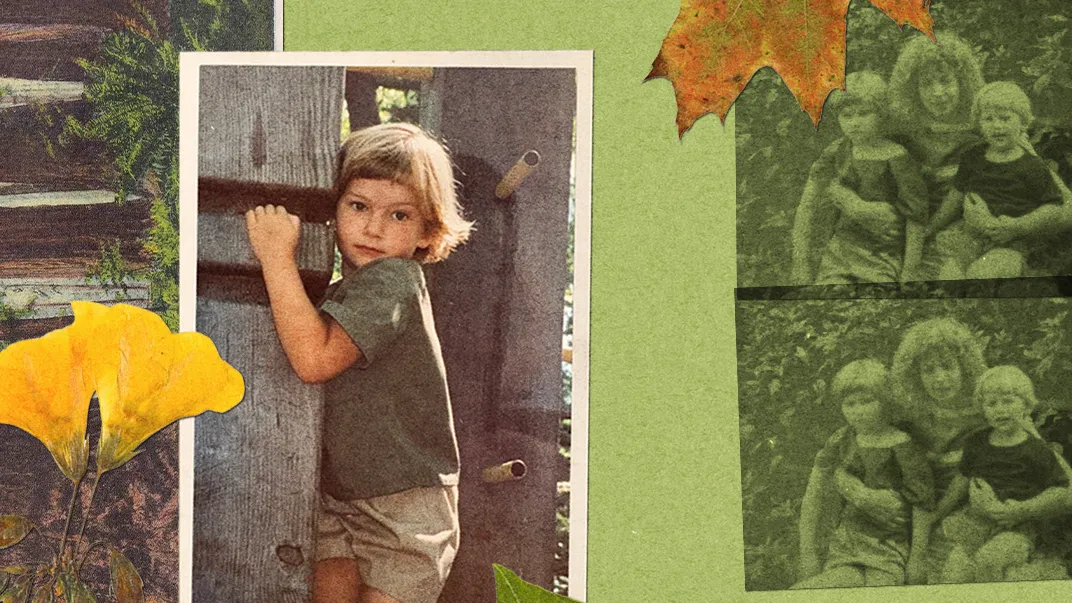
The summer I turned five, my mother sewed me an outfit. Her own mother had been a former art teacher who, in marriage, funneled her creativity into elaborate domestic projects, sewing dresses and skirts and blouses for my mother and her sister. As a young woman, my mother rebelled against this laborious femininity, mostly wearing jeans and loose men’s shirts. But although her mother’s clothes had often felt restrictive, she had also understood them as a communication of love. With a daughter of her own, she decided it was time to try making clothes herself.
She found patterns for shorts and tops—nothing with zippers, because she wasn’t confident she’d be able to pull it off—and bought plain fabrics, inexpensive and sturdy poly-blend. She sewed me two outfits, using the same pattern for each: loose shorts with an elastic waistband and a top with a square neckline and short, squared-off sleeves. One set had dark blue shorts and a lighter blue paisley-print top, the other had tan shorts and an olive top. Around my fifth birthday, that June, she presented them to me to wear at summer camp. I don’t remember exactly what she said about them, but I do remember her eagerness and her transparent anxiety that what she intended as a loving gesture might not be received that way.
This was a reasonable worry, as I was an ornery and particular child. I did not like dolls, I did not like other girls, I did not like any kind of play-acting that involved princesses or babies. I hated dresses, screaming and trying to rip them off when my parents forced them on me for holidays. I loved, to the point of obsession, dogs and books. This was the summer before I started kindergarten—a year when I isolated myself at school, hiding under what I called my “sad tree” at recess, and was sent to a therapist. The therapist asked me to draw myself, and I drew a boy—a boy running away from home. She asked me to select one of the dollhouse dolls to indicate myself. I took a boy doll out of the dollhouse, and I built it a fort on the other side of the room.
You might conclude from this that I was feral and also, not a girl. Not being a girl, however, wasn’t a concept that existed for that therapist or for my parents in 1986, not even in the liberal Boston suburb where I grew up. My friends who have trans children today have books and social media communities and in-person communities and online courses and so many other ways to figure out how to support their children. My parents had none of this, nor even basic language to understand transness—nothing but instincts and empathy. So my mother made me these clothes and gave them to me with a look that mingled pride and pre-emptive apology.
I wore the blue set once or twice and then discarded them. The polyester cloth was scratchy on my thighs, the fit inexact. But as soon as I put on the olive and tan set, I felt a frisson of excitement. They were camouflage colors, like a Boy Scout uniform or the pelt of an animal. Looking at photos now, I can see the more feminine touches—the neckline, the sleeves—but at the time, for me, they were boy clothes. My mother had unwittingly sewn the first clothes that gave me a powerful sense of gender euphoria.
In that outfit I felt both visible in a comfortable way, and also invisible—blending into my natural surroundings like the forest creature I knew myself to be. My parents’ house was on a steep hill. At the bottom of the hill, accessible by crossing two neighbors’ yards, stood a tall pine tree, with evenly spaced, stout branches going all the way up. In my boy clothes, I would climb up as easily as if it were a ladder. Sap sticky on my hands, legs scratched from the rough bark, I would perch on the highest branch strong enough to hold my weight and look all around me.
