

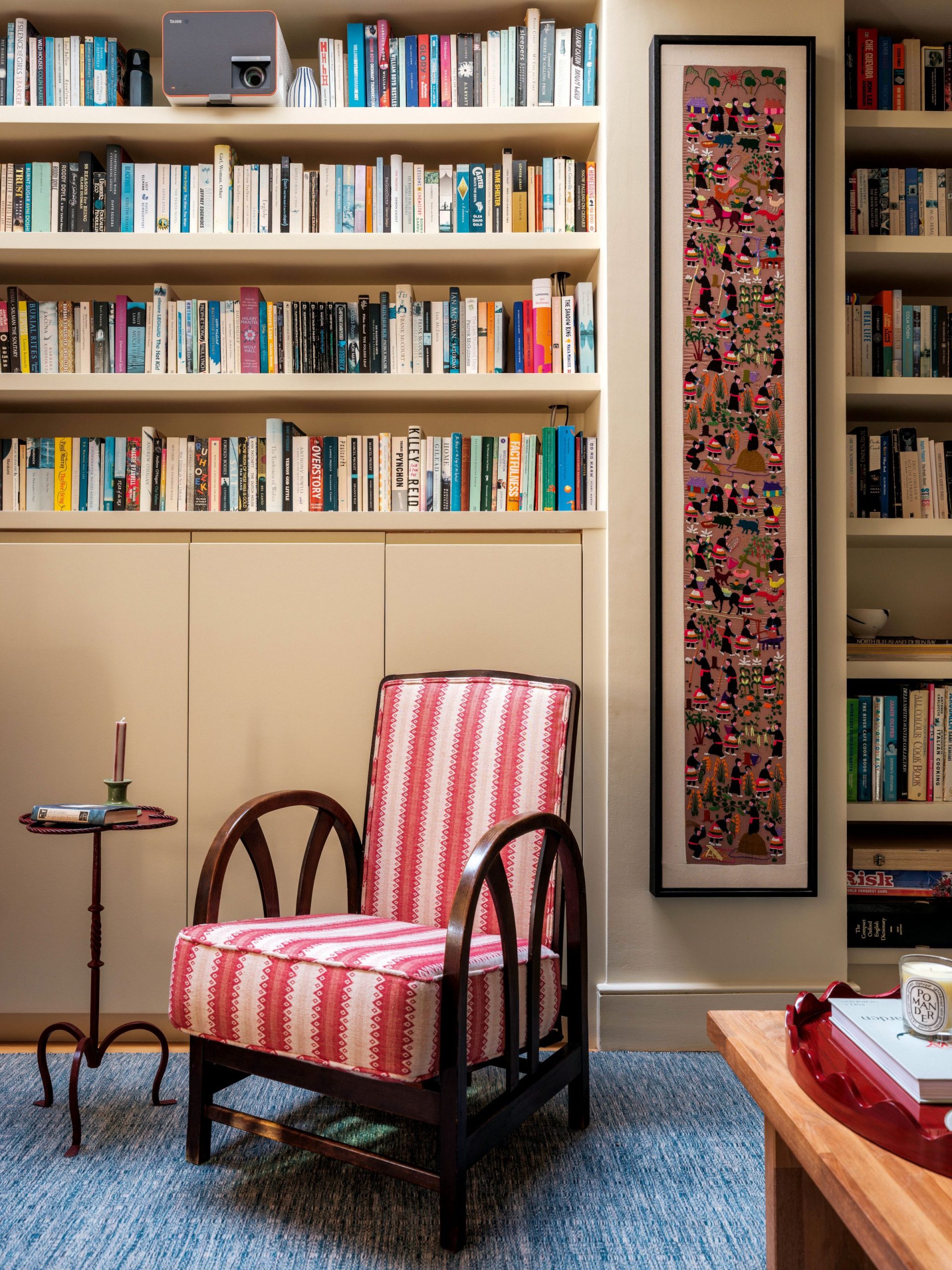
Q: I’ve got lots of books and I love to have them on display — how can I integrate them into my decor so they feel considered and curated, although the shelves are full?

Bespoke joinery designed by Laura Stephens, painted in Clay by Little Greene.
(Image credit: Will Slater)
Books can be so tricky. In the past, there was a trend for color-coding the spines, but that feels a bit contrived now. I totally get that people want to celebrate their books, as they’re such an important part of our lives, but it’s hard to stop them looking like a mishmash.
In a recent project, I decided to make a feature of them in a room where I’d originally intended to use wallpaper, which I scrapped in favor of book storage. I felt the best way to keep them looking neat was to have shelves that were barely any taller than the tallest book — no more than 25cm between each shelf — so you hardly see any wall space behind them. For the lower half of the wall, I had cupboards made that were quite high, so other items could be stashed away. They were painted in Clay by Little Greene, which became the backdrop to the furniture in front of them.
Lastly, I made sure that the books were stacked tidily — all the spines were in a neat row, which made such a difference! The result was a full library that manages not to feel busy and works for how the clients like to live.
Article continues below

Laura Stephens
Laura Stephens is the London-based founder of her eponymous interior studio, whose designs mix pattern, color and traditional features with moments of whimsy.
Q: Where can I look for wallpaper that’s suitable for a hallway? It has to be very durable.
Firstly, I’d say it’s better to do the lower part of the wall in an eggshell paint – Farrow & Ball’s new-ish Dead Flat finish is good for this as it doesn’t mark, and any scuffs can be wiped off.
Above that, I’d go with a vinyl wallcovering — they’ve got so good now that they look and feel like grasscloth but are much more affordable, easier to install, and very hard-wearing. Romo and Osborne & Little have some incredible vinyls, while Christopher Farr has started doing its signature prints in vinyl. You can literally just wipe them down! Perfect for a hallway indeed.
Q: What advice do you have for choosing lampshades made of patterned fabric to work in a bold color scheme?

A living room by Laura Stephens featuring a lampshade from Walter G. Wall lights in a fabric from Fermoie, and walls in Caddie by Paint & Paper Library.
(Image credit: Will Slater)
I love patterned lampshades — they are such a pretty way to highlight what could otherwise be a fairly mundane feature in a room. My advice is to always go for a pleated shade — the folds in the fabric soften the pattern and make it less of a punctuation point, more of an accent. If you were to have the same fabric as a drum shade, it would look very strong, and the light it casts would be so rigid — pleats diffuse the glow, as well as making the print easier to live with.
I’ll pick the lampshades towards the end of my scheme and match them to a non-dominant color in the room. In a living room painted in Caddie by Paint & Paper Library, I used curtains with hints of green in them, which is what I played with for the lampshades. Patterns are always more restful if they link to something somewhere else in the room.
For more inspiring design ideas, sign up to Livingetc‘s newsletter — you’ll get them delivered straight to your inbox.
