

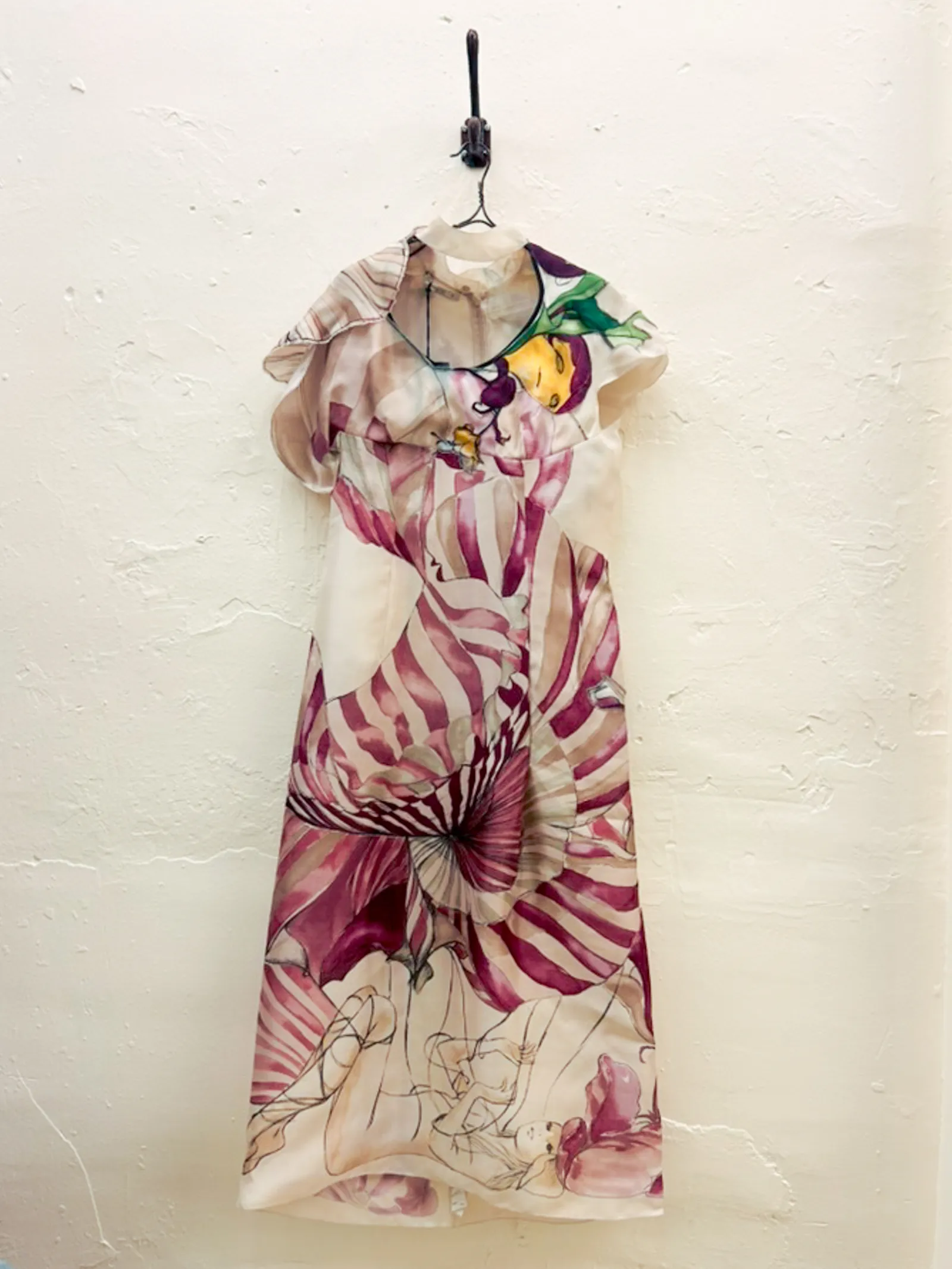
For a certain type of tapped-in shopper, Desert Vintage on the Lower East Side is akin to nirvana. On a recent afternoon, an embarrassment of riches was hanging amid the artfully moldering, half-painted walls and a bathtub filled with dried flowers: a gauzy, painterly dress from Prada’s fabled spring 2008 fairy collection, a cropped python-skin Alaïa biker jacket, and a military-style coat from Martin Margiela’s spring 1993 collection among them.
Downstairs, in a dark, garment rack-lined basement, Zachary Witter was showing me some recent buzzy arrivals. Notably, a pair of peak-shoulder, nipped-waist wool prep school jackets with contrast piping—one in fuscia, the other in cream—from Nicolas Ghesquière’s iconic fall 2007 collection for Balenciaga. Witter is Desert Vintage’s longest-serving employee, save for its current owners, Roberto Cowan and Salima Boufelfel, and is in charge of categorizing and dating the rare and glorious treasures that come through the shop’s doors. For those discerning shoppers entranced not by fresh-off-the-runway finds (too common, too mass-produced), but, instead, garments with history and legacy embedded in their seams, these are holy grails.


“The clothes are more interesting to me as pieces of historical ephemera, and relating them into a lineage,” Witter told Vogue. “The technical stuff… I have no background in that, so it’s not what excites me. When people say, ‘Oh, this has hand finishing,’ I’m like, ‘Explain that to me because that makes literally no sense.’ Whereas if I can look at a tag, I can usually attribute it at least down to a decade.”
Witter is uniquely equipped for a position as niche as this, having started his career cataloging the work of photographer Richard Avedon at the Avedon Foundation in Tucson, Arizona. While the Foundation is headquartered in New York, its archives are kept in the arid desert city because the unique climactic conditions make it ideal for preservation. It’s in Tucson that Witter was born and raised, and, as fate would have it, where Desert Vintage opened way back in 1974; Cowan and Boufelfel took it over in 2012 and have since expanded it to three locations (the third is in Paris).
Growing up, Witter had a deep interest in art, but was also engaged with fashion, enough so to watch runway shows on YouTube between classes. Because of his interest in both archiving and fashion, he often found himself at the shop, perusing the clothes and considering them not just as garments but cultural artifacts, reflections of the eras in which they were produced. “At some point, Roberto and Salima were like, ‘You’re always in here, we should figure out a way that we can utilize you.’”
