

In Minor Keys, the 61st International Art Exhibition, is the final vision of the late Cameroonian-Swiss curator, Koyo Kouoh. It runs from May 9 to November 22 at the Giardini and Arsenale. But the real question during the Venice Biennale, in between exhibits and galleries, is always the same. Where to eat and drink?
My own Venice initiation came embarrassingly late, like Monet, and now it’s become a city I frequent often for the food and bar scene alone—and right now, the bar and dining scene has never been better. 2011 is arguably when it turned, when Massimiliano Alajmo (whose three-Michelin-starred Le Calandre near Padua remains one of Italy’s great restaurants) and his brother Raffaele took over Grancaffè Quadri on Piazza San Marco, and Ristorante Quadri earned a Michelin star within the year. GLAM at Palazzo Venart holds Venice’s only two Michelin stars, the Venice table of Enrico Bartolini, Italy’s most Michelin-starred chef. On Mazzorbo island, Chiara Pavan is known worldwide for her philosophy around environmental cuisine at Venissa. Also at the property is a winery where the near-extinct Dorona grape, resurrected by Gianluca Bisol of the Bisol prosecco family.
For 2026, the arrivals are significant: Heinz Beck now oversees dining at the newly opened Orient Express Venezia in Cannaregio, inside a 15th-century palazzo restored by architect Aline Asmar d’Amman; Airelles Palladio on Giudecca has opened with Nobu Matsuhisa, Jean-Georges Vongerichten, Cédric Grolet, and Norbert Niederkofler (coming in June) under one 16th-century roof; and Zeffirino, the Genoese institution founded in 1939 and once the preferred table of Frank Sinatra and multiple popes, its trofie al pesto finished tableside from a marble mortar, has arrived at Nolinski Venezia.
Outside of the luxurious palazzo hotels, there’s everything in between. “Venice has a great concentration of excellent traditional osterie serving Venetian classics done exceptionally well, alongside great wine bars with a more contemporary look and feel,” says Valeria Necchio, food and culture writer and co-founder of Versatile (a creative work club with two Venice locations). “The flavors are also incredibly distinctive, from the fish marinades to the richly flavorful vegetables grown on Sant’Erasmo.”
On Sant’Erasmo, Osti in Orto, conceived in 2020 by Cesare Benelli of Al Covo, has brought together several Venetian restaurateurs farming four hectares of historic land growing artichokes, radicchio, heritage asparagus, white peaches, and rare varieties almost nobody cultivates anymore. Necchio’s current must-try: the carciofo violetto (purple artichokes), in peak season now and best raw, cooked, in risotto, or with fish carpaccio.
In between Biennale exhibits, here is where to eat, drink, and pull up a stool, by sestiere, the six historic districts that divide the city.
San Marco
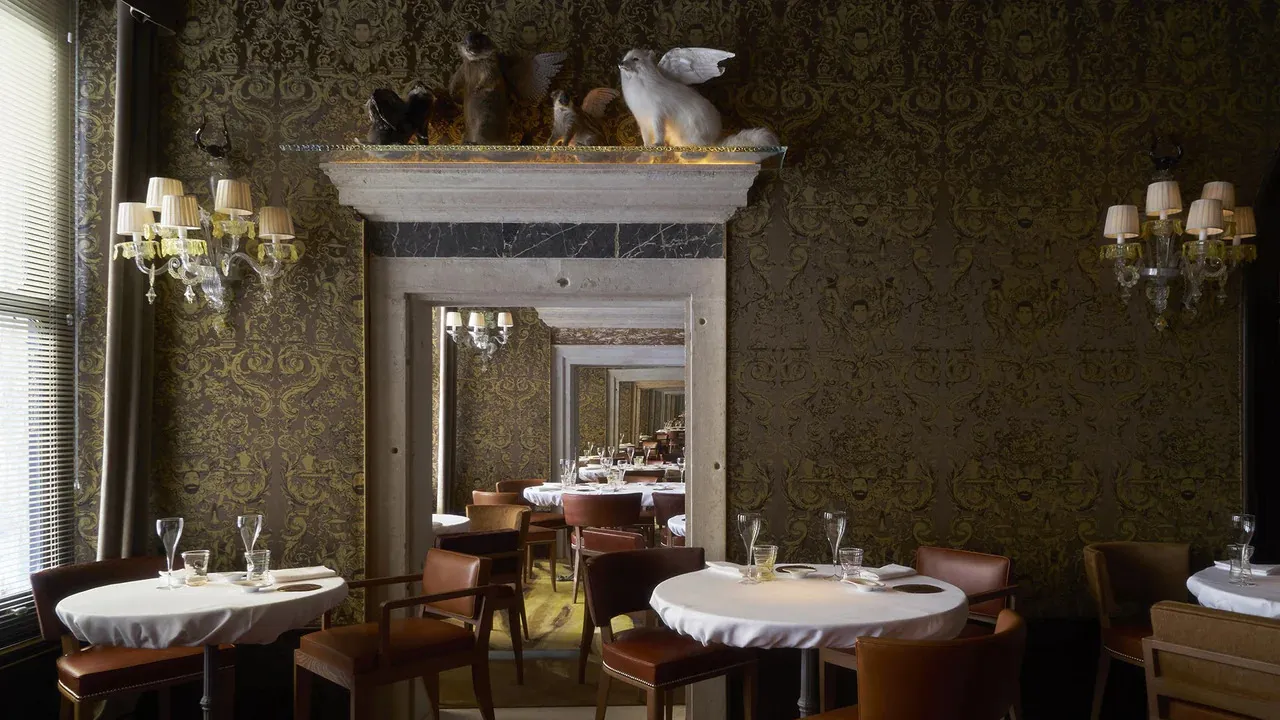
Grancaffè Quadri has anchored Piazza San Marco since 1638 (the space was once the rooms of the Procurators of the Serenissima). Max and Raf Alajmo transformed it into one of Italy’s most elegant dining rooms, and Philippe Starck’s 2018 redesign, with mirrors from the Barbini brothers, Murano glassmakers since 1570, and the same family behind the Hall of Mirrors at Versailles, made it even more so. At Ristorante Quadri, find two tasting menus, including The Quattro Atti, a nod to banquet-style dining at the Doge’s Palace during the Venetian Renaissance. Max’s cappuccino di laguna, frothy, savory, and layered with seasonal lagoon ingredients, is the only cappuccino worth ordering after 11 a.m., and the spaghettoni with smoked butter and caviar is arousal in the form of food. You can also mix and match from the tasting menu à la carte. Below, Raf curates the bar; the Spritz Alajmo, made with Barbaresco Chinato, is the order. Quadrino, the casual outpost on the square, does cicchetti worth stopping for.
