

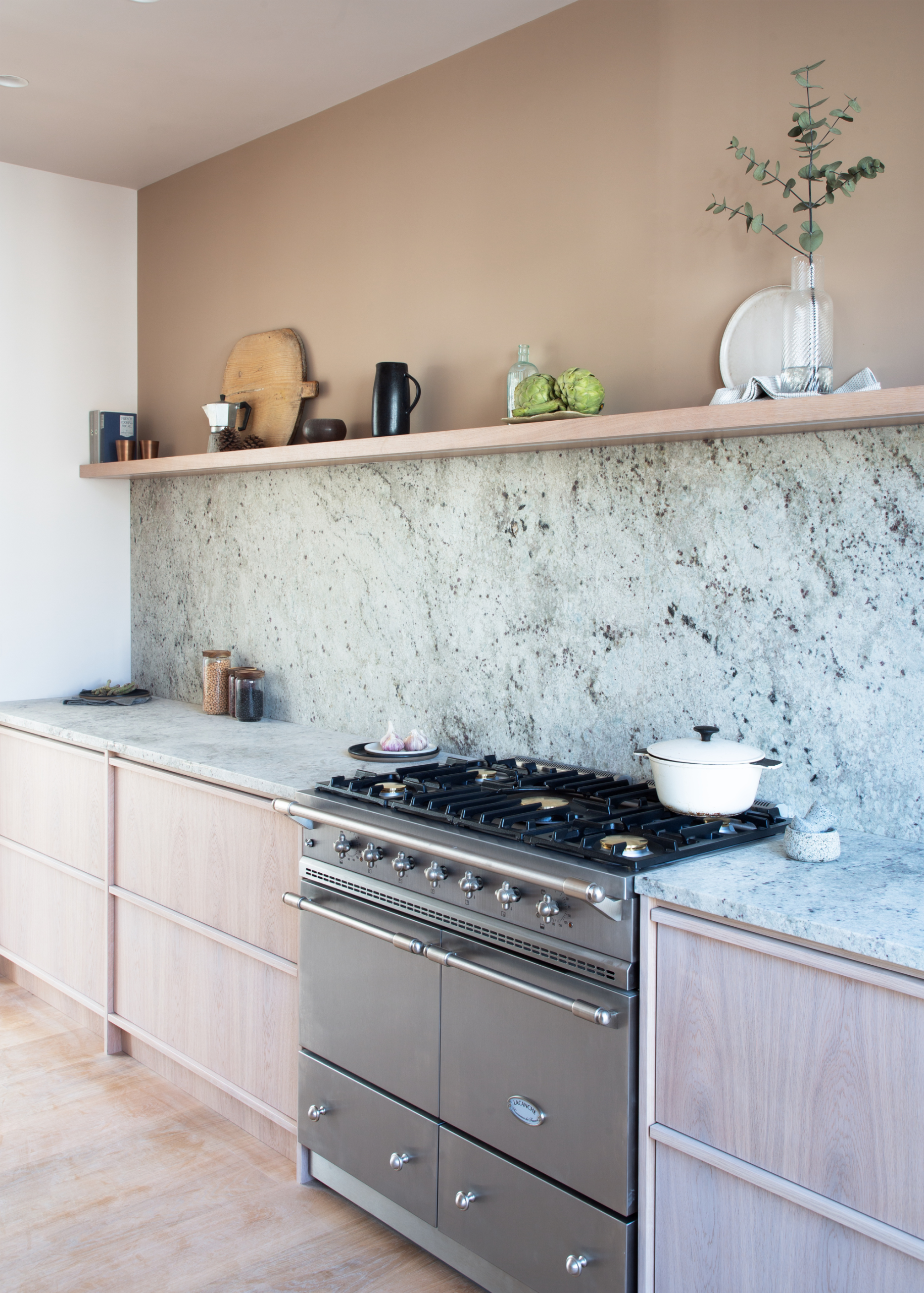
Kitchens have become the hardest-working part of the home, but we aren’t all blessed with the most generous square footage in this area. You may be dealing with a compact footprint, an awkward layout, or simply want your space to feel lighter and more expansive — and thankfully there are plenty of ways to achieve this, without resorting to an extension.
We’re about to delve into the clever use of color and material, along with tricks of scale, proportion, and layout that can transform a cramped space. Making a kitchen feel bigger isn’t just about knocking down walls or extending; no, the most effective modern kitchen ideas are more about understanding how the eye reads the room and how to create a successful scheme that works with, not against, the existing space. Here’s how.
1. Reduce Wall Units

Minimalism may not be for everyone, but surely we can all appreciate this serene scene.
(Image credit: Lauren Moore. Design: Design Assembly )
Overloading a kitchen with wall cabinets can quickly make the space feel closed in. Swapping even just a small section for open shelving or even negative space, for example, can do wonders for creating a greater sense of height and openness, allowing the eye to naturally travel more freely around the room, without feeling suffocated.
Article continues below
As Chelsea Tallentire, a designer at Makers Furniture, explains, reducing cabinetry at eye level is one of the most effective ways to open up a kitchen visually. She also recommends keeping taller elements in one place, “This way the eye moves easily through the space. She continues, “Work with consistent cabinet proportions so everything feels considered and balanced. Storage plays a clever but important role in this. When there is a proper place for everything, countertops stay clear, and the room immediately feels more generous.”

Chelsea Tallentire
With over 16 years’ experience designing bespoke joinery for luxury homes, Chelsea combines her passion for interiors with a keen eye for detail to create thoughtful, functional spaces tailored to each client’s needs. Chelsea thrives in collaborative environments, partnering with fellow designers to bring creative visions to life.
2. Opt for Glass-Fronted Cabinets

This space is working it’s hardest, yet still emanates a naturally fluid design.
(Image credit: Yond Interiors)
If you’re not ready to lose wall units entirely, switching to glass kitchen cabinets is a smart middle ground, or even a combination of both can work well. Unlike solid doors, glass fronts soften the visual weight, making the kitchen feel instantly more open.
As the founder of Walter Studio Interior Design, Perry Walter explains, “Incorporating glass-front upper cabinetry introduces a sense of openness, allowing the eye to travel through rather than stopping at a solid surface.” This simple change can make a noticeable difference, particularly in smaller kitchens.
To amplify this effect, pair the glass cabinetry with a lighter palette across the rest of the scheme. Perry notes that lighter wood tones on the perimeter cabinetry, and a touch of contrast, like a richer, deep-toned island, can be layered in to ground the space without closing it in. The light cabinetry, along with soft off-whites and other reflective finishes, helps to bounce light around the space, creating a brighter, more expansive feel.

Perry Walter
Walter Studio Interior Design specializes in creating timeless, livable, and tailored residential interiors. Perry’s signature style blends traditional and modern influences, drawing inspiration from travel, nature, fashion, art, and architecture.
3. Layer in the Lighting

Cleverly adapted lighting will make sure your small kitchen doesn’t feel dark, too.
(Image credit: Alexander James. Design: Christian Bense)
Kitchen lighting can quite often be treated as an afterthought, but in any kitchen, let alone a smaller kitchen, it plays such a crucial role in shaping how big the space feels. Rather than relying on a single overhead source to cover several different jobs, layers of lighting work much better, giving you options at different times of the day, for different activities, and for different occasions.
As Chelsea explains, there are so many ways to bring it in that will increase the sense of space. “Lighting is often the final layer. I like to introduce it subtly within cabinetry or beneath shelving to lift softer corners and add depth, rather than relying on one central source.”
Integrated lighting, whether that’s underneath wall units, a glow inside cabinetry, or along shelving, creates small, neat pockets of illumination, instantly elevating the ambience and the size of the space.
4. Swap Out Some Cabinets for Open Shelving

This is the perfect example to show you can leave space between things on the shelf. It creates a moment to pause, and that’s deeply appreciated.
(Image credit: Makers)
“Shelving works great in smaller kitchens; it provides both form and function while opening up the space,” Al Bruce, founder of Olive & Barr, explains. Beyond the practical benefits, it also offers the opportunity to introduce personality — and do with that what you like, be it crockery, heirlooms, glassware, or anything you feel is shelf-worthy.
That said, open kitchen shelving shouldn’t feel cluttered, as such. It works best when thoughtfully styled, as too many items sitting together throw everything off balance. Consider with care what you choose to put up there, making the shelving look both stylish and functional. “It does require some thoughtful consideration as to what you put on the shelves. Those who have an abundance of crockery, glassware, and smaller appliances might prefer to keep their belongings out of sight,” adds Al, highlighting the importance of editing what’s on display. Plus, you can change it up as often as you like, which keeps the space interesting and up-to-date.
“Open shelving is still very much in demand as homeowners are seeing the huge benefits,” he says. Not only can it reduce the overall cost of a kitchen, but when done properly, it’ll open up the space and create joy for the items you choose to “showcase”.

TOAST
Rob Towler Slipware Bud Vase in Honey
Keep shelf decor simple but beautiful with objet like this

Al Bruce
Al Bruce began his career over 25 years ago as a cabinet maker. From here, he quickly worked his way up the handmade kitchen industry, finally opening his own company in 2018. Since then, Al has developed a company that prides itself on its quality and craftsmanship, with all their kitchen made and designed in the UK. Utilising local cabinet makers, and hand-sourced materials, Olive and Barr are supplying the country with bespoke, affordable kitchen designs.
5. Get Your Hardware Right

The color, size, and feel of these handles are all well thought out and make for a tidy space.
(Image credit: Hendel & Hendel)
In a small kitchen, hardware can have a surprisingly large impact on how cohesive and spacious a scheme feels. When handles are overly decorative, too bulky, or simply out of proportion with the cabinetry, they can interrupt the visual flow and make the space feel more fragmented.
As Gareth Hull, design lead at Hendel & Hendel, explains, good design starts with proportion. Handles should feel in sync with the size of the door or drawer, but also with how they sit on the surface. “We tend to start by looking at how the length and thickness relate to the door or drawer front, but also how far the piece sits off the surface, because that projection affects both how it feels in the hand and how it looks.” If they protrude too far, they begin to dominate and can be really inconvenient in catching onto things when anyone walks past. Yet, if too little, they risk feeling too slight, and therefore just plain wrong. “There is a balance to find where it feels just right without drawing too much attention,” he says.
The finish is also a huge element to consider. “If you introduce too many different tones across taps, handles, and fittings, each one starts to separate itself, whereas keeping those elements more closely aligned and tonal helps to avoid unnecessary conflict.” So, while mixed metals might be a big kitchen hardware trend, keeping these small (but huge) details on the same page will create a unified look, meaning the overall feel will be calmer, quieter, and most likely more spacious.

Gareth Hull
Gareth is the design lead at hardware brand Hendel & Hendel. He seamlessly blends traditional craftsmanship with contemporary aesthetics for the brand’s collections.
6. Play with Material and scale

Warm, natural surfaces like these, speak for themselves.
(Image credit: Jim Stephenson. Design: Oliver Leech Architects and Ca’ Pietra)
In a smaller kitchen, the materials you choose and how you use them can completely change how the space is perceived. Larger-format tiles for kitchen flooring or surfaces with fewer visual interruptions help to create a calmer backdrop. This will inevitably open up the room and lessen that feeling of confinement.
As Grazzie Wilson, head of creative at Ca’ Pietra, explains, “The right tile creates a sense of continuity, drawing the eye outwards and allowing the kitchen to feel more open, more expansive and less confined by its footprint.” Finishes that gently catch and soften the light can further enhance this effect, subtly lifting the space out of darkness.
“That same sense of continuity becomes even more pronounced when surfaces are carried across both worktops and splashbacks, particularly when using natural stone,” says Grazzie. “Allowing one material to flow from horizontal to vertical planes removes the visual breaks that can make a kitchen feel segmented, instead creating a more unified and expansive backdrop.” She recommends natural stone to be especially effective here, due to its tonal variation and quiet movement, introducing depth without overwhelming the space; this means the surface holds interest while still feeling composed. “When the junction between worktop and wall feels seamless, the eye is not forced to stop and start, and the kitchen begins to feel larger than it is, along with a sense of openness.”

Grazzie Wilson
Grazzie has worked in the interiors industry for more than a decade. At Ca’ Pietra, one of the UK’s leading stone and tile brands, she heads up creative, overseeing product collections as well as the company’s distinctive brand, look and feel. Her stylists’ eye and passion for the technical side of tiling is unparalleled.
7. Consider the Backsplash

It’s obvious really, but a mirrored backsplash really does give the sense of twice the space.
(Image credit: Chris Snook. Design: Makers)
Now, a kitchen backsplash may feel like a purely practical element, but it can really impact how spacious a kitchen feels. Lighter tones, softly reflective finishes, or even extending your wall color across this area can all help to blur boundaries and open up the room.
As Chelsea explains, “A kitchen’s sense of scale is driven more by composition than by its actual square meterage.” She suggests considering where the light enters the room, opting for something gently reflective, such as a mirrored backsplash or glazed finishes, or even using the wall colour on surfaces like the splashback; this can also help increase the sense of space whilst feeling natural and effortless.
Perry suggests, “Incorporating lighter design elements such as a soft-toned tile backsplash to expand the visual boundaries. These finishes reflect natural light more effectively, helping the space read brighter and more expansive throughout the day.”
Taking this one step further, consistency across surfaces can make all the difference. Carrying the backsplash material higher, or even up to the ceiling, will help elongate the space while keeping tones aligned and avoiding unnecessary visual breaks. This should result in much calm and cohesion.
8. Be Strategic With Color

The natural surfaces, color-drenching on various materials, and tactility throughout the whole scheme help give this kitchen a sense of space.
(Image credit: Yond Interiors)
Kitchen color can be one of the most effective tools, but you must use it with strategy in mind. Lighter tones reflect more light, creating an open, airy feel, while richer colors can still add depth without closing the space in.
Softer shades such as blues and greens work particularly well. “Shades of blue will give your kitchen a calming and serene scheme,” Al Bruce explains. “It works particularly well when used across the walls, cabinets, and backsplashes. You can opt for light or navy blue to match your personal preference and existing furniture. Green as an accent color brings life, nature, and freshness to your kitchen. Opting for a shade of green will help to connect the kitchen to the outside space, helping to blend the two areas and giving a more open feeling.” He suggests, from emerald green tiles to light sage, the possibilities are endless.
For those wanting more of a statement look, “You may consider color drenching, following the same colour from the cabinets onto the walls and even ceilings for maximum impact,” this will no doubt reduce visual breaks and give the illusion of more space.
That said, it’s not as simple as defaulting to white. As Charlotte Butler, Kitchen Design Manager at BK Eleven, points out, “White is often the default when people are trying to make a kitchen feel bigger, but it is not a guaranteed solution and, on its own, it can sometimes have the opposite effect. Without anything to temper it, a purely white scheme can feel quite stark, and that lack of variation can flatten the space rather than giving it a sense of depth.” She suggests that if you opt for white, there must be layers of softer neutrals and natural materials such as timber to add depth and honesty.
Ultimately, this is about balance. A palette that flows consistently across the space without abrupt shifts in tone or finish will free up the movement of the eye, making it more comfortable and spacious than it might first appear.

Le Creuset
Traditional Stovetop Whistling Kettle, 2.1l
A whistling kettle on the stove can be the most comforting sound of home

Charlotte Butler
Charlotte is Kitchen Design Manager at BK Eleven, with a background in hotel interiors and a degree in Interior Design. Since moving into bespoke handmade kitchens in 2014, she has built over 14 years of experience shaping kitchens that resolve day-to-day use as carefully as their visual character.
9. Include Banquette Seating

Curved edges to the built-in seating give that extra smooth finish.
(Image credit: Anna Stathaki. Design: A New Day Design)
When space is tight, built-in seating can maximize every inch of the perimeter, without feeling overcrowded. Banquette seating allows you to tuck a dining area neatly into a corner or along walls and celebrate the architectural details you may have in your home. This frees up floor space, allowing room to breathe.
Al says, “The compact nature of its design offers a cosy communal feel, ideal for informal dining. Additionally, the bespoke nature of this style of seating allows for awkward spaces within the kitchen to be utilised, creating dining nooks without taking up precious floor space, helping the kitchen to feel larger and less crowded.” Plus, you’ll always emanate that restaurant/bar ambience with something like this.
10. Consider a Broken-Plan Layout

Awkward (but lovely) spaces call for unique design – this has certainly been throughly planned to make the kitchen the physical divider of the space.
(Image credit: Bjorg Magnea. Design: PJCArchitecture)
Broken-plan layouts strike a clever balance between open and closed, giving you options for different times and occasions, but are specifically effective in smaller or awkwardly shaped kitchens. Rather than fully knocking through walls, this approach intrioduces subtly divisions which will improve the flow and stay open and airy.
“Broken plan layouts have remained a popular choice, as they are still as aesthetically pleasing as an open-plan kitchen but with added functionality,” says Al. By zoning different areas of the kitchen this way, you can create structure and rhythm without compromising light. “For example, a freestanding breakfast bar, open shelving, and panelled glass doors are all features that divide the space without blocking sightlines, maintaining a sense of openness while adding structure.”
Making a kitchen feel bigger isn’t about one design decision, but a series of design choices that work simultaneously. Look into the details, create flow, reduce visual noise, and allow for the eye to travel freely from one element to the next.
Balance is always key, right through from materials, proportion, lighting, and layout, and even the smallest kitchen can feel open and spacious with a good design. It’s not the size that matters, but how well it’s been put together.
And, if you need more inspiration for how to make your kitchen work, why not sign up to the Livingetc newsletter today?
