

Can you even call yourself an Italian fashion dynasty if you don’t own a village? In Umbria, there’s the medieval hamlet of Solomeo, where Brunello Cucinelli’s luxury empire is headquartered across an array of historic buildings, including a library, a theater, and its very own vineyard. In the Biellese Alps of Piedmont, there’s Ermenegildo Zegna’s extraordinarily beautiful nature reserve, Oasi Zegna, where the designer and his family have planted over half a million trees and operate the eco hotel Albergo Bucaneve. Meanwhile, down in Sicily, there’s the Feudo del Castelluccio, where Luisa Beccaria has restored a series of farmhouses and beach villas within the Vendicari Wildlife Reserve—initially conceived as holiday homes for herself and her five children, they’re now also available to rent by the week.
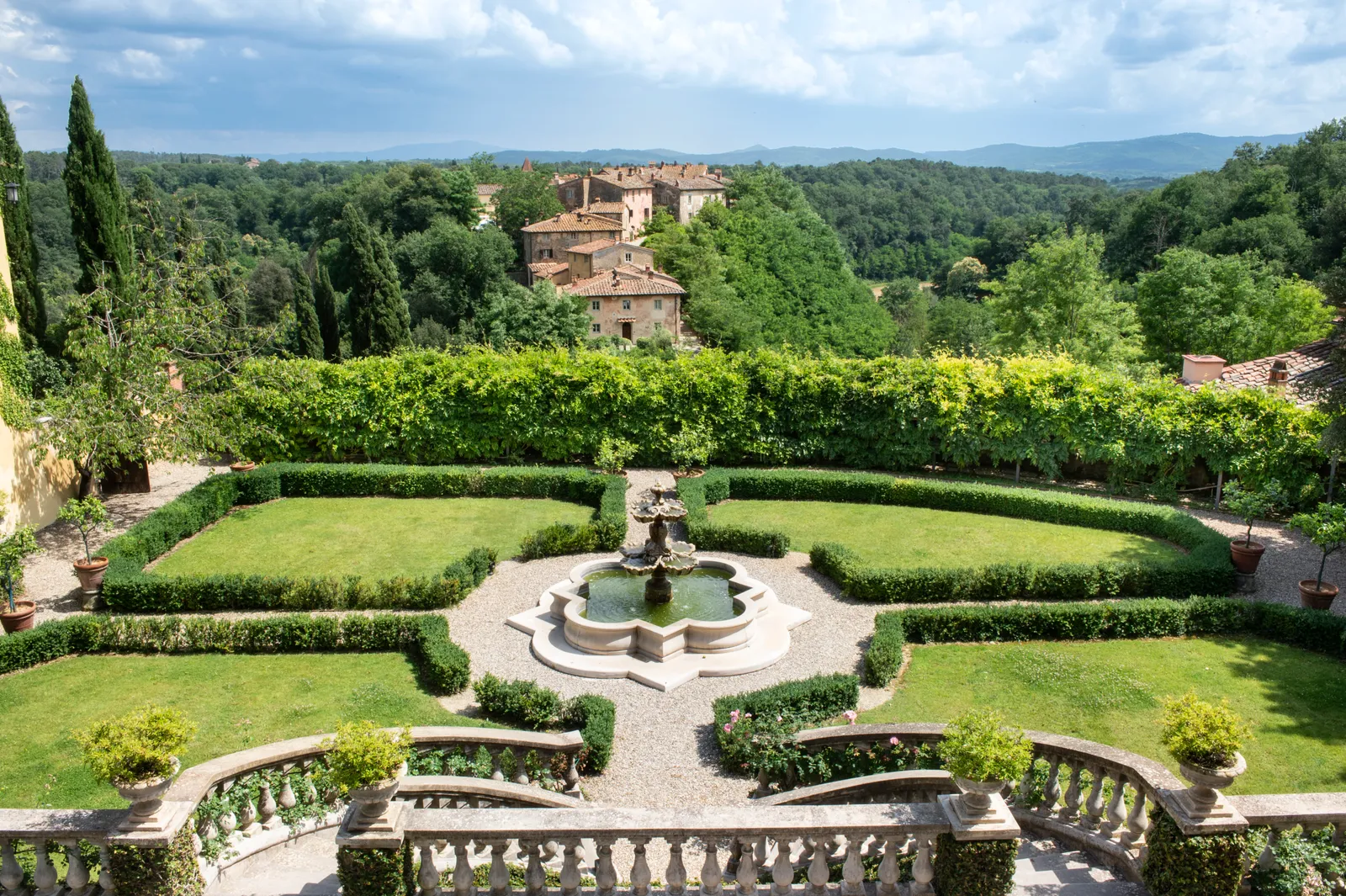
In the heart of the Tuscan countryside, though, you’ll find arguably the most charming fashion family estate of them all: the Ferragamos’ Il Borro. Located around 30 minutes from Arezzo—a town that is categorically worth a visit for its sublime Piero della Francesca frescoes and excellent designer boutiques—and less than an hour from Florence’s outer suburbs, Il Borro is a 1,000-year-old hamlet that has been meticulously preserved (and restored, where necessary) to offer a slice of life as the Tuscans might have experienced it all those centuries ago. (Though, of course, with plenty of modern creature comforts thrown in the mix—but more on those later.)

Photo: Francesca Pagliai
Because to talk about Il Borro, you have to start with its rich and fascinating history. It was purchased in 1993 by Ferruccio Ferragamo, the eldest son of the Florentine leather house’s founder, Salvatore; today, he continues to sit as chairman of the Salvatore Ferragamo board, after a decades-long stint as CEO. And Il Borro remains very much a family affair: his children, Salvatore and Vittoria, are closely involved in the day-to-day operations of the estate, serving as CEO and head of sustainability, respectively. But the story of the borgo stretches back much further—all the way to the Romans, who are believed to have erected a fortress here thanks to its highly strategic position overlooking the crossing of two prominent ancient roads, the Via Clodia and Via Cassia.
Throughout the medieval period, the borgo was fiercely contested by the city states of Arezzo and Florence, while in the 19th-century, the elegant central villa dominating the estate was constructed by a German noble family. During the Second World War, much of the village was severely damaged by German forces—and it wasn’t until Ferruccio stumbled upon it on a hunting trip in the early ’90s, and immediately recognized its potential, that the decades-long project of restoring it to its former glory began.
When I visited on an unseasonably chilly weekend at the beginning of March, the thickly wooded oak and chestnut forests that surround the property were bearing bare, skeletal branches still—though a few almond trees were beginning to sprout the first tiny pink blossoms of the season as I pulled up through the imposing, ivy-clad gates of the estate and up the long driveway flanked by classically Tuscan rows of cypress trees. After stopping at the deliberately low-key reception area—a simple, traditional stone outhouse next to a small boutique offering various bits and bobs made on the estate, from cold-pressed olive oil and organic honey to suede loafers crafted by the village shoemaker—I was handed a detailed, lavishly illustrated map of the estate, and whisked away by electric buggy to my accommodations.
