

The smaller your space, the more noticeable every detail becomes. When everything is encountered up close, design decisions are impossible to overlook, which is why attention to detail matters so much more in compact rooms. If you want a small room to look more expensive, it’s often the finishing touches that have the biggest impact (not your big-ticket items).
While small spaces don’t always have the inherent grandeur of larger rooms, interior designer Siobhan Kelly says they’re often much easier to elevate. “In a compact space, every surface is close, every detail encountered intimately, and nothing escapes scrutiny,” she explains. “Rather than considering this as a limitation, craft and intention are most immediately visible.”
This is why the smallest details often carry the most weight. If you’re on a mission to make a small space feel more expensive, we asked interior designers to share the understated tricks they rely on to upgrade a small room. From quiet upgrades that make a home feel more expensive, such as your hardware or choice of paint finish, they may be subtle, but they promise to make your space feel surprisingly high-end.

1. Opt for a Lustrous Ceiling

Painting the fifth wall with a high-shine finish elevates a small room in more ways than one.
(Image credit: The Brownstone Boys)
When square footage is limited, you have to get creative. One of the most common mistakes when designing a small room is overlooking the power of decorating a ceiling.
To draw the eye up and add a hint of grandeur that will instantly make a small room feel more expensive, NYC-based designer Andrew Suvalsky recommends lacquering the ceiling. “In a small space, a high-gloss lacquer reflects whatever light you have and pulls your eye up, so the space feels brighter and taller,” he says. “It reads as expensive because a good lacquer has a depth flat paint can’t fake, and it takes real skill to get right.”
You don’t necessarily need a high-shine gloss for this paint technique to be effective, either. A color-drenched room with a simple satin finish (as pictured above) can still inject a space with the same elegance and sophistication.
2. Quality Hardware

Your hardware will always be more noticeable in a smaller space, so make it count.
(Image credit: Neptune)
Hardware is like the jewelry of a room. Whether you choose a glistening chrome or an aged brass, these sorts of details work as a pair of signature earrings do in perfecting your outfit. Knobs and pulls, for example, are the sort of kitchen cabinet detail that can make your home look more expensive.
In a small space, they wield even more power since the details are closer and more visible. “A beautifully finished brass handle or a solid rocker switch is noticed in a way that, in a large room, it might not be,” explains Gloria Sanchez of Tailored Living. “Upgrading hardware costs relatively little but has a disproportionate impact on perceived quality. It is one of the fastest ways to make a scheme feel considered and expensive without changing anything structural.”
Besides being more obvious in a small room, Siobhan Kelly adds that there’s a sensory value in the likes of handles and cabinet pulls, which means it can instantly elevate a space. “It is a moment of presence through touch,” she says. “Hardware made from metals that develop a patina over time or incorporate uncommon materials, such as semi-precious stones, are elements that feel tailored to the space.”

Anthropologie
Francoise Knobs
A tactile cabinet pull brings an elevated, considered feel to a small kitchen, while the warm brass finish will catch the light like a piece of jewelry.
3. Smart Space-Saving Solutions

From cabinet inserts to hidden pull-outs, bespoke joinery makes small spaces both more functional and refined.
(Image credit: Project London)
In a small room, functionality becomes even more important. Every element of your storage needs to work harder, which is why bespoke, space-saving solutions instantly make your room feel more considered (and consequently more expensive).
Siobhan, for example, recommends a pull-out bar counter or desk surface integrated within a run of built-in joinery. “The room is not asked to compromise and visually accommodate a constant additional function,” she says. “The quality of the mechanisms used is as important as the cabinetry itself. It’s a satisfying sound when the latch is engaged and the smooth movement of the panel as it is pulled out. It’s an opportunity to create a fully resolved hidden world.”
Take the utility room above, for example. Integrated drying racks and concealed work surfaces help streamline everyday routines despite the limited footprint. The result is a room that feels thoughtfully considered and expertly tailored — the kind of detail that instantly signals investment and elevates the space beyond its square footage.
4. Continuous Flooring With No Thresholds

Seamless flooring gives the illusion of greater space, especially when it continues outdoors.
(Image credit: Design by Workstead)
Replacing your flooring isn’t the quickest or simplest upgrade, but it’s one of those seemingly subtle design decisions that can have a transformative effect. In smaller rooms, especially, visual continuity is key. By minimizing breaks and opting for a single, uninterrupted flooring finish, you create a stronger sense of flow, helping the space feel larger, calmer, and ultimately more elevated.
“Running the same flooring material through from one room to the next, with no threshold strips or transitions, makes a small space feel seamless and expansive,” explains Gloria. “The eye does not stop at doorways, and neither does the sense of space.”
Besides selecting flooring choices that typically make a room look more expensive, Siobhan also suggests full-height doors to give the illusion of yet more spatial sequence. “Thresholds are liminal, and when they are treated with intention, they are moments of arrival,” she says. “A designed event rather than an assembled convenience”.

Siobhan Kelly
Siobhan Kelly is a distinguished architect and designer based in London, UK. With over 20 years of experience in the industry, her focus is on crafting atmospheric spaces and places, in particular within the ultra-luxury residential, wellness, and boutique hospitality sectors. Siobhan has worked for highly regarded practices such as David Collins Studio, Louise Bradley, Candy & Candy, and Foster + Partners, on projects ranging from prime private residences and developments to luxury hotels and spas globally.
5. Layered Lighting

Lighting has the power to transform a small space from dark and drab to high-end.
(Image credit: Laskasas)
If you’ve ever felt as though your small room feels flat and two-dimensional, your lighting could be to blame. A simple overhead light will always feel lackluster, while layered lighting (a combination of ambient, accent, task, and decorative) creates a more cohesive, considered scheme that looks instantly more high-end.
As Andrew notes, the best rooms never run on a single overhead. “One overhead fixture flattens a small room and throws hard shadows that make it feel boxy,” he says. “A few low, warm sources instead — a sconce, a lamp, a picture light — and the room gets depth.”
To upgrade a small room with subtle lighting, Gloria suggests concealed uplighters to create pools of light that add depth and make a space feel larger and more enveloping. “Lighting is the single most cost-effective way to shift how a room feels,” she says. “It is one of the most reliable tools in a designer’s kit and one of the most consistently overlooked by homeowners.”

H&M
Linen-Blend Table Lamp
Accent lighting is just as important in a small room as it is in a large one. Add a soft glow to a small bedroom, living room, or even a kitchen with this decorative scalloped lamp.
6. Add the ‘Unexpected’

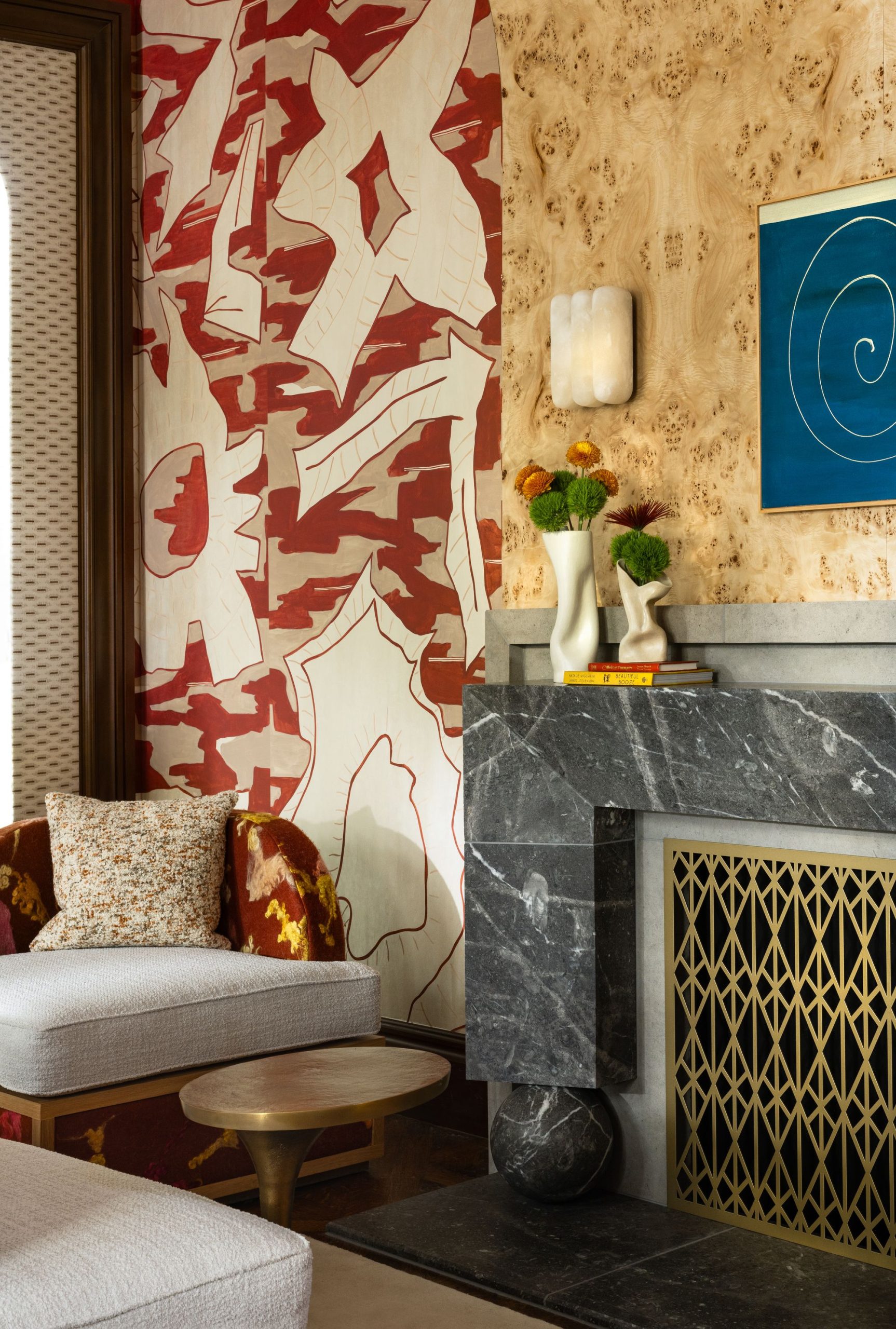
A pop of bright color, a surprising wallpaper moment, a contrasting material — an element of the unexpected will always bring drama and intrigue to a smaller room.
(Image credit: Maestri Studio Interior Design. Fireplace Screen by Modern Metal)

Ferm Living
Up Step Stool
A splash of bright, unexpected color (and in this case, an unexpected form) creates instant intrigue in a small space.
To give a small room the kind of wow-factor typically associated with professionally designed spaces, incorporate an element of surprise. It could be a splash of bold color (the unexpected red theory still has us in a chokehold), wallpaper hidden inside a cabinet, or a striking contrast in materials.
These moments don’t have to be dramatic — they just need to catch the eye. In a compact space, details that prompt a second glance instantly make a room feel more considered, design-led, and ultimately, more expensive.
For interior designer Annie Kantor, her motto is design in unexpected places. “Few projects benefit more from this thinking than a small one,” she says, and they don’t need to take up space, either. “Look around and find the everyday pieces in your home. They likely present the perfect opportunity for a design upgrade with no additional space needed.”
7. Curtains Hung High and Wide

For a hotel-worthy window treatment, drape your curtains from floor to ceiling (and wall to wall).
(Image credit: Husband & Wife)
One of the most effective ways to make a small room feel more expensive is to make it feel more expansive. The way you hang window treatments may seem like an unassuming detail, but it has a remarkable ability to alter a room’s proportions — especially when hung from ceiling to floor and, where possible, extended wall to wall. The effect not only draws the eye upward, creating the illusion of height, but also lends the space a polished, hotel-like quality.
As Gloria explains, the eye naturally follows strong vertical and horizontal lines. “Full-height, full-width curtains make a room read as taller and wider than it is, borrowing visual space the room does not actually have,” she says. “A curtain that starts at the window frame and stops short of the floor looks like an afterthought. One that runs from cornice to floor, wall to wall, looks like architecture.”
For the most luxe-looking treatment, choose pinch-pleat style in a weighty curtain fabric like silk, velvet, or jacquard.
Making a small room feel more expensive isn’t about spending more money — it’s about being more intentional with your design choices. In compact spaces, everything is more noticeable, which means the smallest design details often carry the biggest impact.
The good news? Many of these upgrades don’t require a full renovation. In fact, it’s often the most subtle, minor shifts that carry the most weight. Whether you’re in a bid to make your kitchen look more expensive or you want to give a small bedroom a boutique hotel quality, the design tricks above prove that thoughtful details are often the most transformative of all.
For more inspiration, subscribe to Livingetc’s newsletter.
