

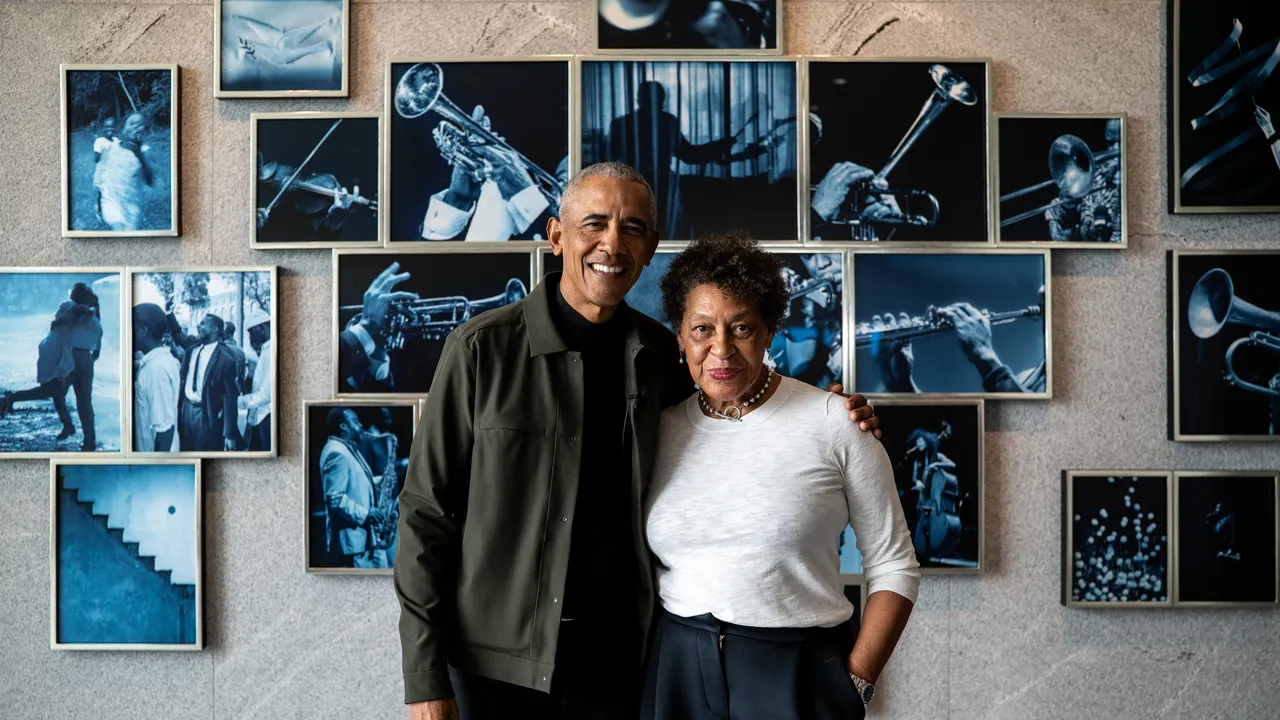
When photographer Carrie Mae Weems first got a call about creating a new commission for the Obama Presidential Center back in 2023, she found herself revisiting a conversation she’d had with her friend Butch Morris, the late cornetist and composer, in the days following Barack Obama’s historic presidential victory 15 years earlier.
The two were at lunch, discussing what Obama’s win would mean for America—and especially for Black Americans—and how they might capture such a moment in their art. Morris’s answer was immediate. “I hear the blare of trumpets,” he told Weems.
Weems circled around that notion as she imagined, and abandoned, several ideas for what would eventually become The Cool Blue Wind, a 29-piece photo collage installed on the top floor of the museum tower.
The piece is one of 28 site-specific works created by 30 artists, including Mark Bradford, Maya Lin, Julie Mehretu, and the late Richard Hunt, for the 19-acre site on Chicago’s South Side. Together, the works—commissioned by Virginia Shore, the longtime director of the State Department’s Art in Embassies program—stand as one the most ambitious undertakings on the sprawling campus, which will open to the public on June 19.

Photo: The Obama Foundation
“The center is really so much about dialogue, about convening, about bringing people together,” says Louise Bernard, the center’s museum director. “The arts are an amazing vehicle for doing that work.” The commissions, she adds, are “able to speak to the idea of hope and possibility” and “bring a sense of gravity to the convening areas.”
Few artists seem better suited to such an assignment than Weems. A MacArthur fellow and the first Black woman to receive a retrospective at the Guggenheim Museum, Weems, 73, is one of the most influential voices in contemporary American photography. For more than four decades, the multidisciplinary artist has created work that probes the stories America tells about itself. Her landmark Kitchen Table Series (1989–90), for example, used the intimate terrain of family life to illuminate larger questions about race, gender, and class. In The Museum Series (2005–06), Weems appears with her back to the camera outside institutions such as the Louvre and Tate Modern, questioning whose histories museums preserve and canonize, and whose they exclude. And in Blue Notes (2014–15), a series of blurred and atmospheric portraits of Black cultural figures, Weems considers the ways racism has obscured and diminished the legacies of Black American icons.
