

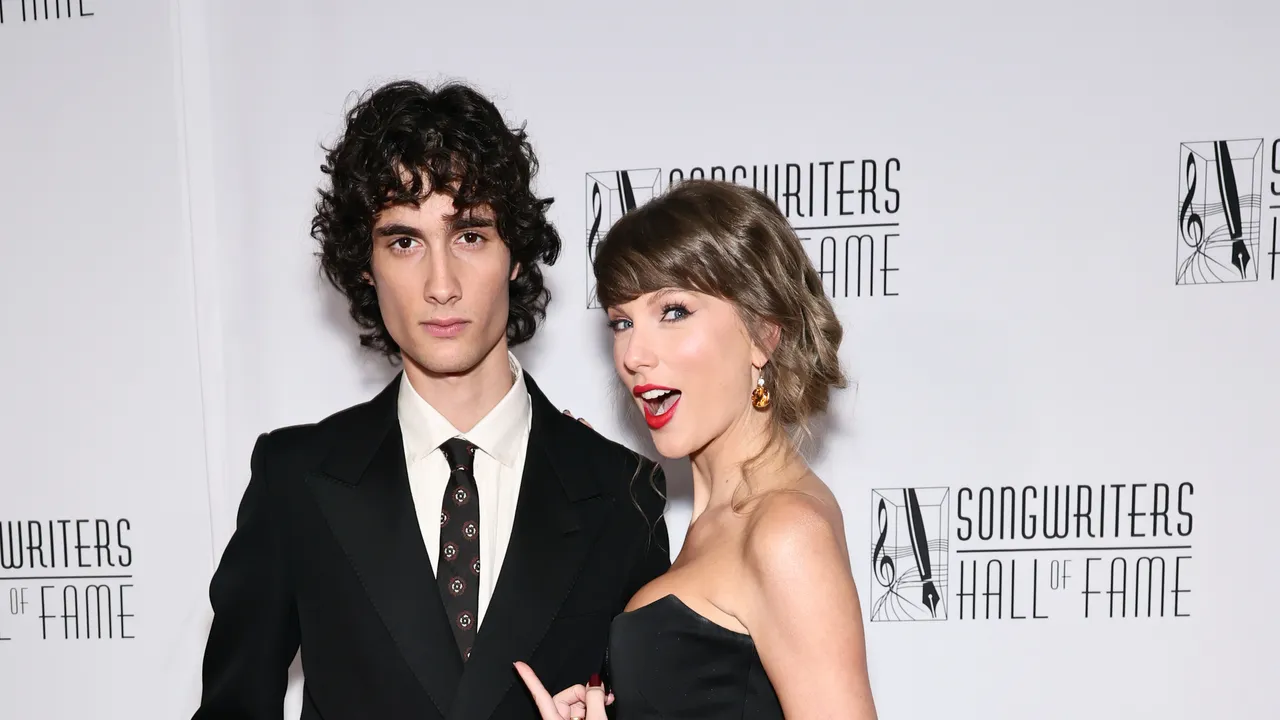

Sombr and Taylor SwiftTheo Wargo/Getty Images
As a few hundred guests steadily trickled into the ballroom of the Marriott Marquis in Times Square just before 7 p.m. for the annual Songwriters Hall of Fame induction ceremony, a crowd had already formed around the table where a Givenchy-clad Taylor Swift and her family, plus the director Steven Spielberg and his wife Kate Capshaw, stood accepting well-wishers. On Thursday evening, at 36 years old, the chart-topper officially became the youngest-ever female inductee to the institution.
A couple feet away, two teenage girls—the daughters of the a music licensing exec and a rare exception to the event’s 21+ age restriction—looked on in disbelief. “We are shaking,” one of the star-struck teens told Vogue, clutching her sister’s hand. Since their mom is a board member, they typically attend the ceremony every year—but this one was different. “We were really lucky to be brought today because there’s such high security…usually there’s a lot less.” (If there’s a better way to win ‘cool mom’ brownie points, we’ve yet to hear it.)
Indeed, three body guards surrounded Swift throughout the night, leaving for a different post nearby only when her fiancé Travis Kelce arrived just as the ceremony began a little after 8 p.m. The Taylor Swift Effect—particularly in a room of A&R guys, musicians, producers, label heads, and lawyers—was as palpable as it was at the Knicks game the night before. But as songwriter Graham Lyle put it in his acceptance speech early on in the night, “Sometimes I think this business forgets that the song is the start of the whole thing.”
The evening, which began with cocktails at 6 p.m. and stretched out until after 12:30 a.m., was an ode to the song: as a medium, artistic practice, and a product worth paying creators fairly to make. The night celebrated the good songs, the great songs, “the kind of songs that become part of people’s lives,” as one presenter said, but also the early, half-baked, and downright bad songs—which honoree John Fogerty waxed poetic about during a 30-minute speech. Alanis Morissette called out the songs that act as survival tools; classics that seem to appear to the songwriter out of thin air, and the everyday habit of writing to pursue them even when there seemingly is no divine inspiration or lightning bolt from the sky.
